
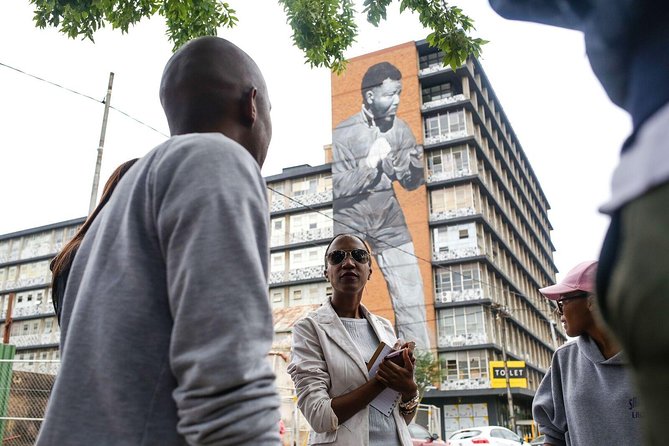
Reviewed · WALKING TOURS
Innercity Walking Tour
Johannesburg reveals itself best at street level, and this four-hour outing takes you well beyond the usual bus-window view. You’ll move from Maboneng’s art studios and street scenes to an old traditional market, a giant second-hand bookshop, and the law office once shared by Nelson Mandela and Oliver Tambo. The city’s changes are the main story.
I like the mix of ordinary city life and major landmarks, and I like that the guide helps you understand public transport and local history as you go. The main consideration is that this is a walking tour with several hours on your feet, and one French-language review noted that part of the experience used a minibus rather than being entirely on foot.
Key points at a glance
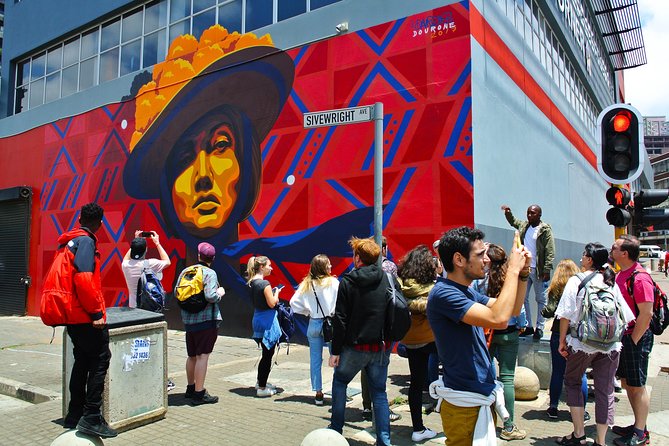
- Maboneng in 45 minutes: See how a once-neglected inner-city district became a center for artists, designers, and small businesses.
- Kwa Mai Mai Market: Browse traditional medicines, clothing, beadwork, walking sticks, and crafts in one of Johannesburg’s oldest markets.
- Carlton Centre views: Spend an hour hearing how the gold rush, urban decline, and city-center renewal shaped Johannesburg.
- Mandela and Tambo’s office: Visit Chancellor House and the nearby Shadow Boxing sculpture.
- Public transport practice: Learn how Johannesburg’s transport system works rather than simply watching the city through a vehicle window.
- Small-group format: The maximum group size is 20, which is useful when streets, markets, and book stacks require attention from the guide.
Why this Johannesburg walk feels different
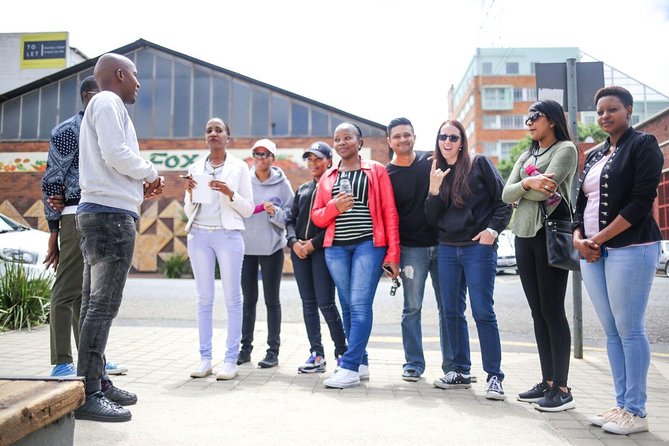
Many city tours keep you sealed inside a vehicle. This one puts you on pavements, in market lanes, and among the changing blocks of Johannesburg’s inner city. That matters here because the city’s story is not only told by grand buildings. It is also visible in murals, shopfronts, informal stalls, renovated buildings, and busy public spaces.
You’ll walk through areas with very different moods. Maboneng is associated with art and redevelopment. Kwa Mai Mai gives you a more traditional market experience. The Carlton Centre provides a high view over the city, while Gandhi Square and Chancellor House connect Johannesburg to Mahatma Gandhi, Mandela, and Tambo.
The result is not a polished sightseeing circuit. It is a closer look at how a city changes, including the uneven parts of that change. Your guide is important here. Guides named Thepso and Brite have been associated with this experience, and the strongest part of the outing is the personal explanation of places that are easy to miss on your own.
A few more Johannesburg trips to weigh up
- Soweto: Walking Tour with a Local Guide and Lunch
★ 4.9 · 648 reviews - Soweto Walking Tour with Lunch
★ 5.0 · 288 reviews - Johannesburg: Local Food Tasting Guided Walking Tour
★ 4.7 · 192 reviews
Starting at 302 Fox Street
The tour begins at 10:00 am at 302 Fox Street in Jeppestown and returns to the same meeting point. This location puts you near Maboneng, so the first stop comes quickly rather than after a long transfer from a hotel district.
You should arrive ready for a moderate amount of walking. Comfortable shoes matter more than smart clothes, and a mobile ticket keeps the check-in simple. The group can include up to 20 people. That is not a private walk, but it is still small enough for a guide to provide commentary while moving through streets and market areas.
An air-conditioned vehicle is included, even though walking is central to the tour. The itinerary and one piece of feedback indicate that a minibus may be used for part of the route. If you expect four uninterrupted hours on foot, keep this in mind. The vehicle can be welcome in Johannesburg’s heat, but it means the experience is partly a walking tour and partly a short city transfer.
Maboneng: art, renewal, and hard questions
The first stop is Maboneng Precinct, with about 45 minutes set aside. The name means Place of Light, and the district has become known for its artists, designers, entrepreneurs, galleries, and creative businesses.
What makes the stop useful is the contrast. Not long ago, this inner-city area was widely viewed as unsafe and run down. Art became part of a plan to bring activity and investment back into the district. As you walk, the guide can help you read the area not just as a stylish place for photos, but as an example of urban renewal.
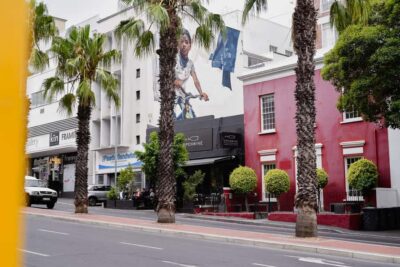
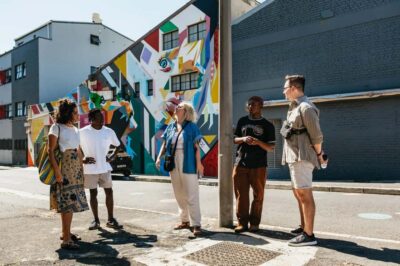
You’ll likely notice street art and the district’s creative character. One of the most appealing parts of the visit is simply walking through the neighborhood instead of stopping for a quick photograph from a coach. You have time to look at the buildings, public art, and street activity at ground level.
Still, Maboneng is not the whole of Johannesburg. It represents one form of redevelopment, and its polished side should be viewed beside the more traditional and less renovated places later in the tour. That contrast is useful. It helps you avoid reducing the city to either decline or renewal.
Kwa Mai Mai Market and Johannesburg’s living traditions
Next comes Kwa Mai Mai Traditional Market, for roughly 30 minutes. This is described as one of Johannesburg’s oldest markets, occupying what was once an old horse stable. More than 176 stalls offer traditional medicines, African clothing, beaded items, artifacts, walking sticks, and handmade crafts.
This is one of the tour’s best stops if you want to buy a souvenir with a stronger connection to local life than a standard gift-shop item. The market’s value is not just in shopping. It gives you a look at traditional goods and practices that are easy to miss if you spend your time only in galleries, malls, and major monuments.
Thirty minutes is enough for an introduction, though not enough for a leisurely browse of every stall. Keep your expectations realistic. This is a working market, not a museum display arranged for visitors. Your guide can provide context and help you understand what you are seeing.
If you plan to buy something, carry small personal items securely and ask questions before taking photographs. The supplied information does not promise shopping assistance or photography arrangements, so follow your guide’s direction. This is also a place where respectful curiosity will serve you better than treating every stall as a photo opportunity.
Same country, a completely different kind of day:
- From Johannesburg: Pilanesberg Nature Reserve Game Safari
★ 4.8 · 1,327 reviews - Johannesburg: Hop-On Hop-Off Bus with Optional Soweto Tour
★ 4.6 · 985 reviews - Soweto /Johannesburg and Apartheid Museum Guided Full Day Tour
★ 5.0 · 932 reviews - Johannesburg Hop-On Hop-Off City Tour with Soweto Option
★ 4.5 · 768 reviews
Collectors Treasury, eight floors of paper history
Collectors Treasury receives about 15 minutes, making it the briefest stop. It is described as the largest second-hand bookstore in the Southern Hemisphere, filling an eight-storey building with books, LPs, maps, porcelain, and postcards.
Fifteen minutes is enough to get a taste of the place, but book lovers may wish for more time. The sheer vertical scale is the point. You are not entering a tidy shop with a few shelves of used titles. You are seeing a dense collection spread through an old city building.
I like this stop because it adds texture to the tour. Johannesburg is often explained through gold, politics, architecture, and social change. A giant second-hand bookstore brings in another strand: the objects people collect, read, keep, and pass on.
The practical drawback is simple. You may have to move on just as you begin spotting interesting books or maps. Think of this as an introduction rather than a dedicated book-shopping visit.
Carlton Centre and the view from 223 meters
The Carlton Centre gets the longest stop, about one hour, and for good reason. Built between 1969 and 1976 by the American architectural firm Skidmore, Owings and Merrill, the skyscraper rises 223 meters above Johannesburg.
From this height, the city’s shape becomes easier to understand. Your guide will connect the view to the gold rush of 1886, the decline of the inner city during the late 1980s and 1990s, and the current effort to bring life back to the center. The view is not just a photo stop. It is a lesson in how Johannesburg expanded and changed.
This is probably the clearest place to hear the tour’s central argument: the inner city is not frozen in its worst years, but neither has every problem disappeared. From above, you can take in the scale of the City of Gold and see why mining, business, transport, housing, and redevelopment all matter to its story.
An hour allows room for explanation and sightseeing. If heights make you uncomfortable, this will be the stop to consider carefully. The information provided does not specify exactly which observation area you will use, but the experience is built around panoramic city views from the building.
Gandhi Square and the center’s public face
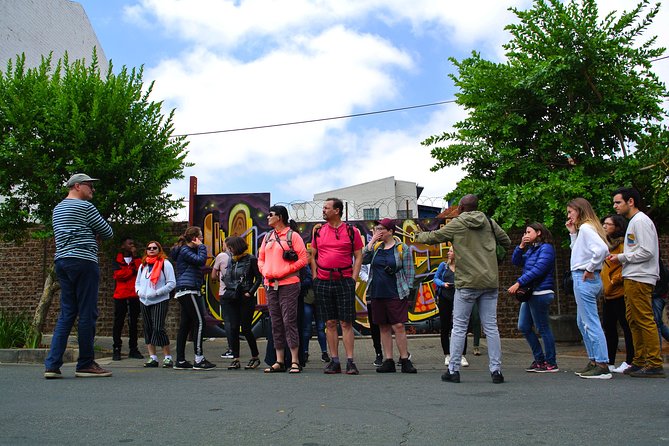
The tour then spends about 20 minutes at Gandhi Square. The square is named for Mahatma Gandhi, who lived in South Africa for 21 years and operated his law firm in downtown Johannesburg.
This stop links the city’s streets to Gandhi’s time as a lawyer and human rights activist. It also gives you another look at the public spaces of central Johannesburg, after the high view from Carlton Centre.
Twenty minutes is a short visit, but it fits the walking route well. You’ll hear the relevant story without giving up too much time at the larger stops. The square works best as a connecting point between the city’s commercial past and the political history that follows at Chancellor House.
Chancellor House and the Mandela connection
The final major section takes you through the Main Street mining district toward Chancellor House. The building is a modest three-storey structure that housed Mandela and Tambo Attorneys in the 1950s. Their practice was South Africa’s first black-owned law firm.
This is a valuable stop because it is more modest than the famous monuments associated with Mandela. You are looking at an ordinary urban building tied to a major chapter in South African history. That physical scale can make the story feel more direct.
Opposite Chancellor House is the Shadow Boxing sculpture by Marcos Cianfanelli, based on a well-known image of a young Mandela boxing. The sculpture adds a visual link to Mandela’s early life and public image, while the former law office places him in the working life of downtown Johannesburg.
The stop lasts about 30 minutes, enough for the guide to explain the legal practice, the Main Street mining district, and the sculpture. If political history is your main reason for booking, this section may be the tour’s strongest payoff.
What the guide adds to the experience
The route covers a lot in four hours, but the places become much more useful when someone explains the links between them. A guide can show you why Maboneng is different from Kwa Mai Mai, how the gold rush shaped the city, and why Chancellor House matters beyond its size.
The commentary is described as in-depth, and that is important because several stops are easy to misunderstand without context. A market can look like a row of stalls. A skyscraper can look like a photo platform. A small law office can look like just another old building. The guide turns each into part of a larger story.
You’ll also receive help with navigating Johannesburg’s public transportation. That is a practical benefit for anyone staying in the city for more than a day. The tour does not turn you into a transit expert in four hours, but it gives you a better sense of how to move around outside a private vehicle or organized excursion.
The named guides Thepso and Brite have been singled out in connection with warm, engaging tours. Your actual guide may differ, so the exact personality and pace can vary. Still, the format depends heavily on a guide who is willing to explain, answer questions, and keep the group together across several distinct parts of the city.
Is $50.04 a fair price?
At about $50.04 per person, this is not the cheapest way to walk around Johannesburg. The price becomes easier to justify when you count the four-hour duration, guide commentary, admission fees, Carlton Centre visit, market access, and the included air-conditioned vehicle.
You are also paying for orientation. Johannesburg’s inner city is not a simple set of monuments arranged along one pedestrian street. A guide helps connect places that you might otherwise visit without understanding how they relate to one another.
The value is strongest if you want history, local context, and a route that includes places beyond standard sightseeing. It is weaker if you only want a quick overview, dislike walking, or would rather choose one neighborhood and explore it slowly.
Lunch and refreshments are not included. Plan to eat before the 10:00 am start or after the tour finishes, since the four-hour schedule does not include a meal.
Who should book this tour?
I would choose this for a first or second visit to Johannesburg if you want to understand the inner city rather than only see its best-known attractions. It suits curious visitors who enjoy markets, architecture, street art, political history, and walking between stops.
It is also a good fit if you want a guide before using public transport on your own. The group limit of 20 keeps the outing from becoming enormous, though anyone seeking a quiet private walk should look elsewhere.
You should have a moderate level of physical fitness. The tour involves walking through several districts and spending time on your feet. The vehicle portion may offer a break, but you should not book this expecting a fully vehicle-based city tour.
The route also suits visitors who prefer an honest city portrait. You’ll see redevelopment, creative businesses, traditional commerce, major views, and sites linked to South Africa’s political past. You will not get a single, tidy version of Johannesburg, and that is part of the value.
Booking details worth knowing
Your confirmation arrives when you book, and the activity is near public transportation. The meeting point is 302 Fox Street, Jeppestown, Johannesburg, 2043, and the tour begins at 10:00 am before returning there.
Free cancellation is available if you cancel at least 24 hours before the start time. Cancellations or changes made inside that window are not accepted for a refund, so check your plans before the cut-off based on local time.
The experience is recommended by 98 percent of its published audience and carries a 4.9 rating from 46 reviews. Those figures suggest a strong record, but the practical details matter more: expect a moderate walk, a maximum of 20 people, some vehicle use, and no included lunch.
Should you book the Innercity Walking Tour?
Book it if you want street-level Johannesburg with context, especially Maboneng, Kwa Mai Mai Market, the Carlton Centre, and Chancellor House in one half-day. The route gives you a useful balance of art, commerce, architecture, public history, and everyday city life.
Skip it if you need a slow, private walk, cannot manage moderate physical activity, or want to spend most of your time inside a vehicle. For everyone else, the $50.04 price is reasonable for four hours of guided sightseeing and orientation, particularly on a first visit. Bring comfortable shoes, arrive ready for changing city scenes, and leave room for the guide’s explanations to shape what you see.
FAQ
Where does the Innercity Walking Tour begin?
It begins at 302 Fox Street, Jeppestown, Johannesburg, 2043, South Africa.
What time does the tour start?
The tour starts at 10:00 am.
How long does the tour last?
The experience lasts approximately four hours.
Where does the tour finish?
The tour ends back at the meeting point at 302 Fox Street.
What places are included?
The route includes Maboneng Precinct, Kwa Mai Mai Traditional Market, Collectors Treasury, Carlton Centre, Gandhi Square Precinct, and Chancellor House.
Is transportation included?
Yes. An air-conditioned vehicle is included, and the route also involves walking. One part of the experience may use a minibus.
Are admission fees included?
Yes. All fees and taxes are included.
Is lunch included?
No. Lunch and refreshments are not included.
Can I cancel for a full refund?
Yes, if you cancel at least 24 hours before the experience’s start time. Cancellations or changes made less than 24 hours before the start time are not accepted for a refund.
Just added around Johannesburg
- Private Soweto Tour 5 hours approximately from Johannesburg or Pretoria.★ 4.5 · 9 reviews
- bicycle tour soweto★ 4.5 · 20 reviews
- Two day Kruger National Park Safari from Johannesburg★ 5.0 · 19 reviews
- Airport & Private Shuttle and Transfer Services in Johannesburg★ 5.0 · 9 reviews
- Taste of Africa★ 5.0 · 9 reviews
- Sun City Day Tour From Johannesburg★ 4.5 · 6 reviews
- Pilanesberg National Park Safari, BIG 5 Full Day★ 5.0 · 4 reviews
- Full-day Johannesburg Bike Or Walking tour – With Transport★ 5.0 · 10 reviews
Walking Tours, compared.




Browse the lists this tour appears in