
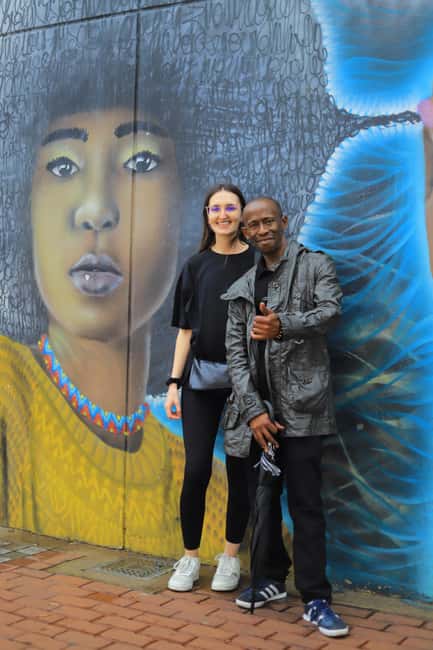
Reviewed · JOHANNESBURG TOURS
Johannesburg: The Evolution of Maboneng (Place of Light)
Maboneng means place of light in seSotho, and the name fits this part of eastern downtown Johannesburg. In two hours, you move from old heritage buildings to giant murals, shipping-container housing, art spaces, a traditional healers’ market, and one of the world’s largest second-hand bookstores. It is a compact lesson in how entrepreneurship and public art can change a city block by block.
I like two things especially. First, the tour gives you street-level context, not just pretty photographs. You hear how Maboneng developed and why its new buildings matter. Second, the walk brings together parts of Johannesburg that are easy to miss on your own, from the Cosmopolitan heritage building to Arts on Main and the Kwa Mai-Mai market.
The main caution is value. At $42 per person, this is not a cheap stroll, and the experience can feel more like a guided walk than a full tour. One departure ended about 20 minutes early, and another did not include the market visit described in the plan. Ask at the start which stops are possible that day.
Key Points at a Glance
- Two hours on foot: Begin and end at Curiocity Backpackers on Fox Street.
- A changing neighborhood: See old Johannesburg buildings beside new developments made with shipping containers.
- Street art with a story: Learn about local and international mural artists, including Nelson Makamo.
- Traditional culture: The route is intended to include Kwa Mai-Mai, one of the city’s oldest traditional healers’ markets.
- Arts and books: Visit Arts on Main and The Collectors Treasure, described as the largest second-hand bookstore in the southern hemisphere.
- Guide quality matters: Guides such as Tsepho and Eko have been praised for their local insight, but the standard of engagement may vary.
Starting at Curiocity on Fox Street
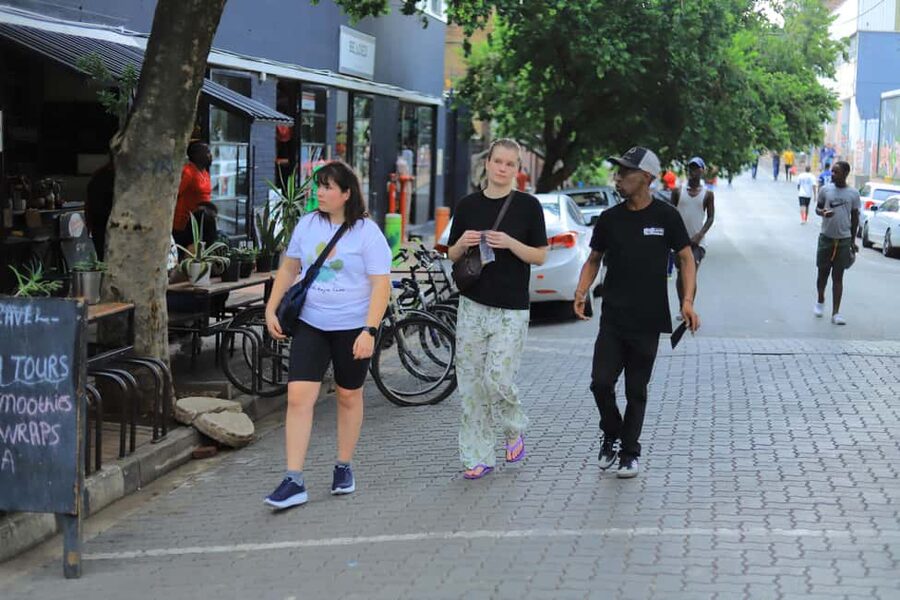
The tour starts at Curiocity Backpackers, 302 Fox Street, in Jeppestown. This is a useful meeting point because it places you right inside the Maboneng precinct rather than at a distant transport hub. You do not spend the opening part of the tour getting into a vehicle or driving between sights.
Your guide sets the tone from here. The best version of this walk is conversational, with time to explain what you are seeing and how the area has changed. Tsepho has been singled out for explaining Maboneng’s past and present, while Eko has also been praised for his account of the neighborhood’s origins. Names and guides can change, so treat those as examples rather than a guarantee.
Wear shoes you can comfortably walk in for two hours. The tour is not suited to people with limited mobility, mobility impairments, or pregnant women. You should also dress for the weather, since this is an outdoor walk with stops inside some venues.
Other Johannesburg days people book alongside this one:
- From Johannesburg: Pilanesberg Nature Reserve Game Safari
★ 4.8 · 1,327 reviews - Johannesburg: Hop-On Hop-Off Bus with Optional Soweto Tour
★ 4.6 · 985 reviews - Soweto /Johannesburg and Apartheid Museum Guided Full Day Tour
★ 5.0 · 932 reviews
From Johannesburg’s Early Suburbs to Maboneng
Before focusing on art and new development, the walk places Maboneng within the story of Johannesburg’s first suburbs. That background matters. Without it, the district can seem like a collection of fashionable cafés, murals, and converted buildings. With it, you get a better sense of why the area has attracted artists, business owners, developers, and visitors.
Maboneng has changed quickly over the past two decades. The tour looks at that change through its buildings and businesses, rather than treating urban renewal as an abstract idea. You see how older structures sit beside newer projects and how creative work has become part of the area’s public identity.
This is also where the walk’s limits appear. A two-hour route cannot explain every stage of Johannesburg’s urban development or fully explore the social effects of regeneration. You get an introduction, not a full city-history course. I would treat the tour as a helpful first look at Maboneng, then spend extra time in the district if your schedule allows.
The Cosmopolitan, a 1899 Survivor
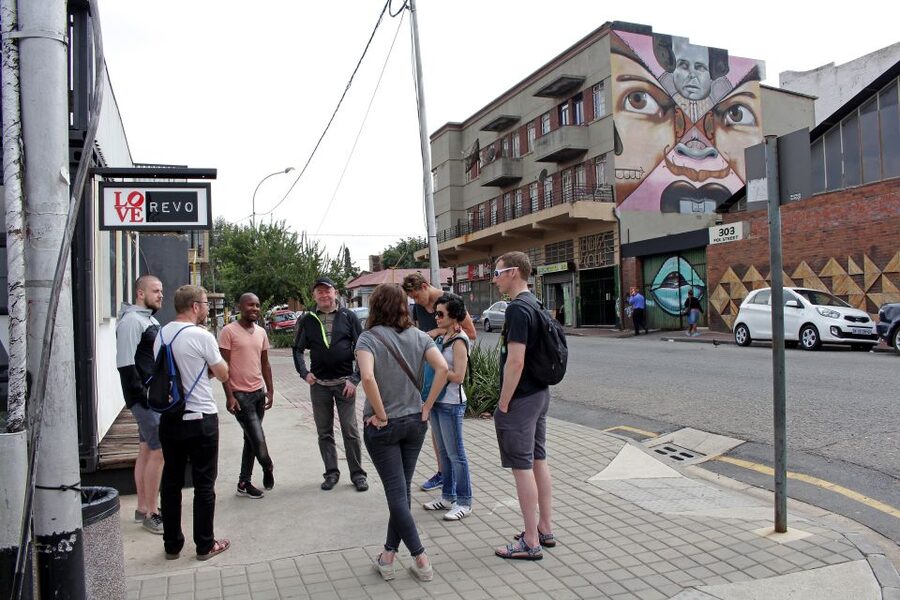
One of the route’s most striking heritage stops is The Cosmopolitan. Built in 1899 and opened as a hotel and bar in 1902, it represents an older Johannesburg, long before Maboneng became associated with murals, galleries, and design-led development.
The appeal here is not simply the age of the building. It gives your guide a chance to talk about the people and businesses that once shaped downtown Johannesburg. The building’s past suggests the many layers beneath the district’s newer image. You may not get access to every part of it, but seeing it from the street still helps anchor the story.
I like this stop because it prevents the tour from becoming an art-only walk. Maboneng is not just new paint on old walls. It is a place where commercial, social, and architectural changes overlap.
Drive-lines and the Practical Side of Renewal
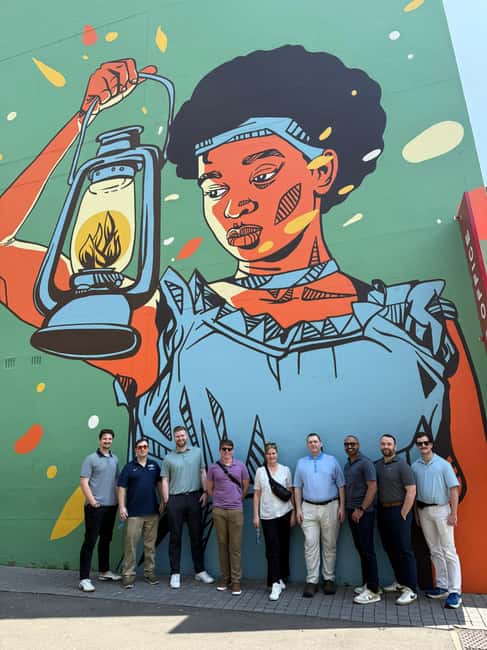
The Drive-lines Development shows a more recent answer to the need for affordable housing. The project uses upcycled shipping containers as living spaces, making it one of the route’s clearest examples of creative reuse.
This stop adds practical weight to the idea of urban regeneration. A mural is easy to admire, but a housing project raises harder questions about who gets to live in a changing neighborhood and what new development is meant to achieve. The walk introduces that conversation without pretending that one building can explain the whole issue.
You will see this development as part of a larger sequence: older buildings, creative venues, public art, and new housing. That sequence is one of the strongest reasons to take the tour with a guide rather than simply wander around for photographs.
Same country, a completely different kind of day:
- Johannesburg Hop-On Hop-Off City Tour with Soweto Option
★ 4.5 · 768 reviews - Full Day Ultimate Pilanesberg National Park Safari from Johannesburg or Pretoria
★ 4.5 · 718 reviews - Half-Day Tour of Soweto Tour
★ 4.5 · 712 reviews - Soweto: Walking Tour with a Local Guide and Lunch
★ 4.9 · 648 reviews
Murals by Nelson Makamo and Others
Public art is central to the Maboneng experience. The tour points out murals by local and international artists and explains how walls can change the feeling of a street. Instead of treating the artwork as background decoration, your guide helps connect it to the district’s identity.
A major stop is the Mandela mural, described with the memorable image of Nelson Mandela as a boxer. The walk also highlights murals by Nelson Makamo in what is presented as an open-air museum. These works give you some of the route’s best photo opportunities, but the visual impact is only part of the point.
I find the public art section especially useful for first-time visitors because it gives you something to look for after the tour. You begin noticing scale, placement, and the way a mural interacts with a building. Art becomes a clue to the neighborhood’s changing ambitions.
Do not expect a formal gallery talk or a fixed exhibition. Outdoor art can be altered, painted over, or viewed differently depending on the route and conditions. The experience is strongest when you are curious about the stories behind the walls, not only searching for a particular photograph.
Arts on Main and the Kentridge Connection
Arts on Main is one of Maboneng’s best-known cultural stops. It is associated with William Kentridge, one of South Africa’s most celebrated artists, and with his foundation, The Centre for the Less Good Idea.
This part of the walk shows how an old urban district can become a base for artists and creative organizations. It also gives the tour a more focused cultural stop after the large outdoor murals. You may find that the atmosphere here feels different from the open street: the work is connected to institutions and studios rather than only public walls.
Access can depend on the day and the route. The information for the experience names Arts on Main as a stop, but it does not promise a private meeting with artists or entry to every space. One version of the experience was specifically expected to include contact with artists, but that did not happen. Book this walk for the neighborhood’s art setting and explanation, not for a guaranteed artist encounter.
Kwa Mai-Mai and Traditional Healing
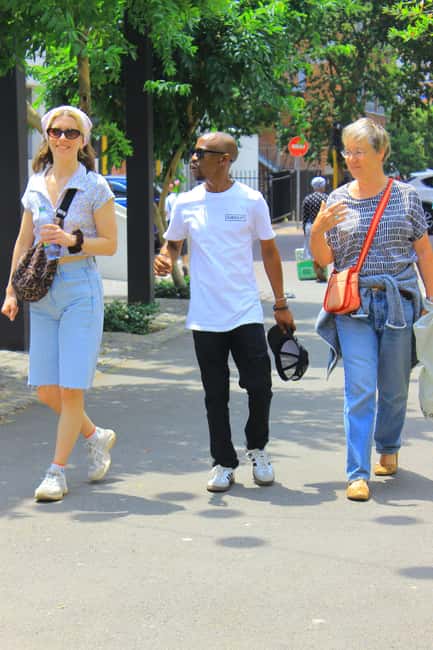
The planned route continues to Kwa Mai-Mai Traditional Healers’ Market, described as one of the oldest markets of its kind in Johannesburg. This is where the tour moves beyond contemporary art into living cultural practice.
You may encounter sangomas, traditional medicines, and traditional clothing. For many visitors, this is one of the most distinctive parts of the walk because it offers a view of Johannesburg that is not usually represented by galleries or new architecture. It is also a place where respectful behavior matters. Listen to your guide, ask before taking photographs, and remember that the market is a working cultural and commercial space, not a stage set.
The market visit is an important point to confirm before you set out. One departure did not include it, despite the planned itinerary. The reason is not given, so the route may change with timing or local conditions. If Kwa Mai-Mai is your main reason for booking, ask whether the stop is included that day.
The Collectors Treasure, A Booklover’s Reward
The final major stop is The Collectors Treasure, described as the largest second-hand bookstore in the southern hemisphere. This gives the tour a fitting finish. After seeing Maboneng through buildings, murals, and markets, you can browse a place built around old ideas, printed pages, and collected objects.
A bookstore stop also gives you a chance to slow down. The walk covers many themes in a short time, and this kind of venue can make the neighborhood feel less like a sightseeing route and more like a place where people work, shop, and spend time.
The description does not specify how long you will have to browse or whether purchases are expected. If you love books, leave room in your bag and budget, but do not count on a long shopping session. The tour has several possible stops to fit into two hours.
Rooftop Views If Time Allows
If time permits, the walk may finish with a drink and a view over the Johannesburg skyline. This is an attractive way to end the route, especially after seeing the city from street level.
The phrase if time allows is important. The rooftop finish is not a fixed promise, and a tour that runs late at an earlier stop may not reach it. One departure finished early, which makes timing worth watching. If you are hoping for a sunset view, check the schedule and ask your guide at the beginning.
The skyline stop is a bonus rather than the core of the experience. The main value lies in the neighborhood walk and the explanation of its buildings and art.
Is $42 a Fair Price?
At $42 per person, the cost is reasonable only if you place a high value on having a local guide explain the district. You are paying for a two-hour English-language walk, not transport, a meal, or a long list of paid admissions.
I would compare it with the cost of wandering around Maboneng alone. You can see murals and buildings without paying a tour fee, but you may miss the connections between the Cosmopolitan, Drive-lines, Arts on Main, Kwa Mai-Mai, and the bookstore. The guide’s interpretation is the product.
The price feels less convincing if the walk ends early or skips several named stops. One person felt the activity was too expensive because it was mainly a walk, and that is a fair concern. To get good value, confirm the route, arrive ready to walk, and make use of the guide’s local knowledge by asking questions.
Safety, Pace, and What the Walk Demands
The experience is presented as a way to visit the neighborhood safely with a guide. That matters in downtown Johannesburg, where a visitor unfamiliar with the area may prefer not to work out a route alone.
Still, a guided walk is not a substitute for common sense. Keep your belongings secure, stay with the group, and follow the guide’s directions. Littering is not allowed. The supplied information does not give a group size, so you should not assume a small private tour.
The pace and walking surface are not described in detail. Since the tour is not recommended for people with mobility impairments, consider your comfort with a two-hour urban walk before booking. Comfortable shoes are essential.
Who Will Enjoy This Maboneng Walk?
I would recommend it most strongly to a first-time visitor interested in Johannesburg’s creative side, public art, and city change. It suits you if you want a broad introduction rather than one narrow subject. The mix of murals, heritage buildings, art spaces, traditional culture, and books gives the walk variety.
It is also a good fit if you prefer a local guide to explain what you are seeing. The strongest guide experiences have included clear stories about Maboneng’s origins and plenty of information about the neighborhood. Good guides can turn a short walk into a useful orientation for the rest of your time in Johannesburg.
I would be more cautious if you expect every listed stop, a formal artist meeting, or a full two hours packed with activities. The route can change, and the quality depends heavily on the guide and the day. This is not a museum tour with a guaranteed sequence of rooms.
Should You Book The Evolution of Maboneng?
Book it if you want a guided introduction to Maboneng and care about the reasons behind its murals, buildings, and new projects. The tour’s best moments come from the connections between old Johannesburg and the district’s newer creative identity.
Before paying $42, ask which stops are operating that day, especially Kwa Mai-Mai, Arts on Main, and the rooftop finish. If the guide is engaged, the walk offers a safer and more thoughtful way to get your bearings in this part of the city. If the route is shortened or several stops are missed, the price becomes harder to defend.
You can reserve now and pay later, and cancellation is available up to 24 hours before the start for a full refund. That flexibility helps, but the real booking decision is simple: choose this for local explanation and urban context, not merely for a two-hour stroll.
FAQ
How long is the Maboneng walking tour?
The guided walking tour lasts two hours.
Where does the tour start?
It starts at Curiocity Backpackers, 302 Fox Street, Jeppestown, Johannesburg, 2043, South Africa.
Where does the tour end?
The activity ends back at the meeting point.
What language is the tour offered in?
The tour is offered in English.
What should I bring?
Bring comfortable shoes and clothing suited to the weather.
Is the tour suitable for people with limited mobility?
No. The tour is not recommended for people with limited mobility or mobility impairments.
Can I cancel for a full refund?
Yes. You can cancel up to 24 hours in advance for a full refund. You can also reserve your place and pay later.
Just added around Johannesburg
- Lion park★ 4.5 · 5 reviews
- Lesedi cultural village:★ 5.0 · 6 reviews
- Lesedi Cultural Village with lunch or dinner cultural food★ 4.6 · 9 reviews
- Lesedi Cultural Village★ 4.9 · 4 reviews
- Lesedi Cultural Village Half-Day Tour★ 4.7 · 9 reviews
- Kruger National Park – 5 Day Safari Tour★ 4.7 · 4 reviews
- From Johannesburg: Kruger National Park 4-Day Luxury Safari★ 4.8 · 9 reviews
- Kruger National Park – 4 Day Safari Tour★ 4.8 · 19 reviews
Johannesburg Tours, compared.


Soweto /Johannesburg and Apartheid Museum Guided Full Day Tour
Read our review →
Johannesburg Hop-On Hop-Off City Tour with Soweto Option
Read our review →

Jo’berg in 1 Day: Soweto, Apartheid Museum & City Tour
Read our review →
Full-Day Tour with Soweto and Apartheid Museum
Read our review →Browse the lists this tour appears in