
Reviewed · CITY TOURS
Johannesburg City Centre Walking Tour
Johannesburg reveals itself best at street level, and this tour puts you in the middle of that complicated story. You’ll walk from Gandhi Square past old Main Street buildings, the Workers Museum, Chancellor House, and Mary Fitzgerald Square, then finish with a braai lunch in the arts-focused Maboneng Precinct. I like the local scale of it, and I like that guides such as Mathapelo, Tebogo, Clement, and Sibongile explain both the proud and difficult sides of Jozi. The drawback is that city-centre walking requires attention, and the exact mix of stops and transport can vary.
I especially like the small group size, capped at 10 people, and the practical care built into the route. Guides have helped visitors arrange an Uber, used a taxi for a less comfortable stretch, and checked that people got back safely. The $45.19 price is fair if you want local context, a guided introduction, and lunch, though extra transport, food additions, and other purchases cost more.
Key points before you book

- Chancellor House brings legal history to street level: See the former office where Nelson Mandela and Oliver Tambo worked together.
- The Workers Museum gives the city’s labor story a human face: Allow time for its compact but useful look at Johannesburg’s compound system.
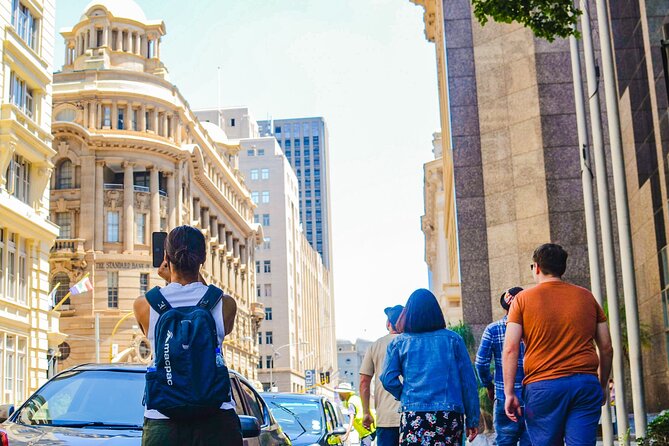
- Main Street mixes old architecture with present-day Jozi: This is a good place for photographs and street-level observation.
- The Top of Africa adds a wide city view: It gives you a useful sense of Johannesburg beyond the pavement.
- Maboneng supplies the satisfying finish: Expect a braai-style meal, with plant-based options available.
- A local guide matters here: The route crosses parts of the city that can feel hard to read on your own.
Why this three-hour walk works in Johannesburg

Johannesburg can be difficult to grasp from a car window. Its size, security concerns, changing neighborhoods, and layered past make the center feel less straightforward than a typical sightseeing district. This walk gives you a person to interpret what you are seeing and helps you move through the city with more confidence.
The tour begins outside Nando’s at Gandhi Square in Marshalltown. That is a practical meeting place near public transport, and it puts you close to the old central business district from the first minute. The experience is generally around three hours, but the walking portion may feel longer or shorter depending on pauses, questions, and the way the group reaches Maboneng.
I would book this early in a Johannesburg stay. The experience is often reserved about 21 days ahead, and it works well as an orientation before you make other plans. You will learn which parts of the center interest you, which places deserve a longer visit, and how the city’s past connects with its present.
A few more Johannesburg trips to weigh up
- Soweto: Walking Tour with a Local Guide and Lunch
★ 4.9 · 648 reviews - Soweto Walking Tour with Lunch
★ 5.0 · 288 reviews - Johannesburg: Local Food Tasting Guided Walking Tour
★ 4.7 · 192 reviews
Gandhi Square and the first steps through Main Street
Gandhi Square is more than a place to meet. It helps you see how central Johannesburg functions as a transport and business district, while also carrying the name of Mahatma Gandhi, who lived and worked in South Africa before returning to India. The tour uses the square as a starting point before moving toward Main Street.
Main Street is the first substantial stop, with about 30 minutes set aside for it. Expect a walk past older buildings and reminders of Johannesburg’s gold-mining era. This is a good stretch for photographs, but the value lies in the guide’s explanation of what the buildings represented and how the center has changed.
I would not expect a polished, museum-like route here. The city center can show wear, and some buildings may look tired. That is part of the point, but it can also feel confronting. You see the gap between Johannesburg’s economic importance and the condition of some central streets. A guide helps turn that contrast into useful context rather than letting it remain a confusing first impression.
The Workers Museum and Johannesburg’s labor story
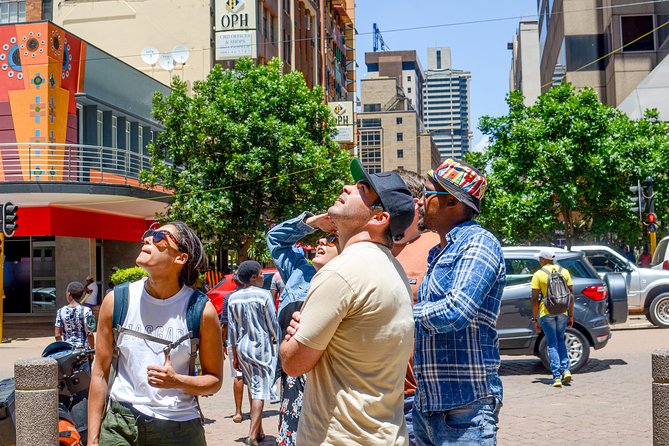
The Workers Museum is scheduled for about 20 minutes. It occupies a former compound and focuses on the lives of migrant workers, a subject central to understanding Johannesburg’s growth and South Africa’s segregationist past.
This is one of the most worthwhile stops because it shifts attention away from grand buildings and famous names. Johannesburg was built through mining and industrial labor, often under harsh systems that separated workers from their families and controlled where they lived. The museum gives that story a physical setting.
I would listen closely here and ask questions. The stop is not long, so you will not have time for a slow museum visit. Still, those 20 minutes can add a human scale to the city’s economic story. The guide’s role matters greatly, and the strongest guides on this experience, including Mathapelo, Tebogo, Kutlwano, and Clement, are praised for answering questions and adding personal explanation rather than reciting dates.
Chancellor House and the Mandela-Tambo connection
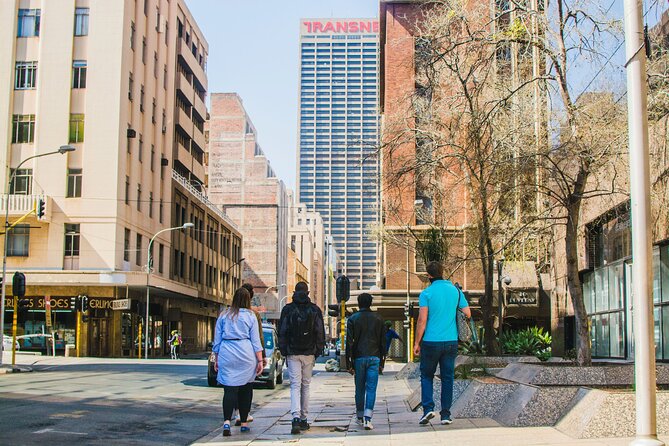
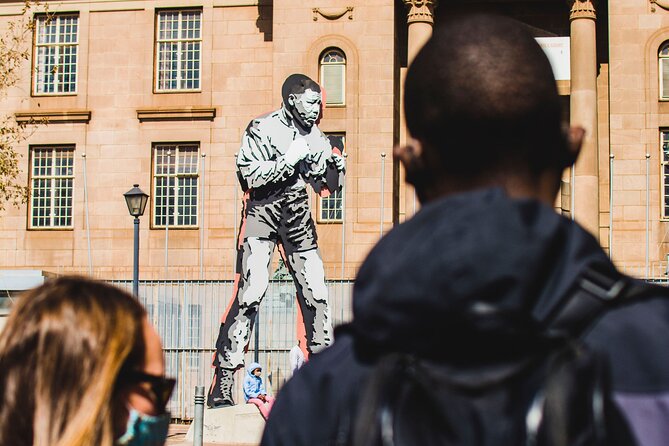
Chancellor House is a brief stop of about 15 minutes, but its importance is much larger than the time suggests. This was the office where Nelson Mandela and Oliver Tambo established South Africa’s first Black-owned law firm.
The site connects national political history with an ordinary office address in the center of town. You are not only hearing about Mandela as a later president and global symbol. You are seeing where he and Tambo worked as lawyers and challenged the legal structure of apartheid.
The short visit suits the walking format. You will get the essential story and a chance to take photographs, but this is not a full museum session. If Mandela’s legal career is a major interest, you may want more time elsewhere in Johannesburg. For a first look at the city, however, Chancellor House is a strong reminder that major political change often begins in modest places.
Same country, a completely different kind of day:
- From Johannesburg: Pilanesberg Nature Reserve Game Safari
★ 4.8 · 1,327 reviews - Johannesburg: Hop-On Hop-Off Bus with Optional Soweto Tour
★ 4.6 · 985 reviews - Soweto /Johannesburg and Apartheid Museum Guided Full Day Tour
★ 5.0 · 932 reviews - Johannesburg Hop-On Hop-Off City Tour with Soweto Option
★ 4.5 · 768 reviews
Mary Fitzgerald Square and the city in motion
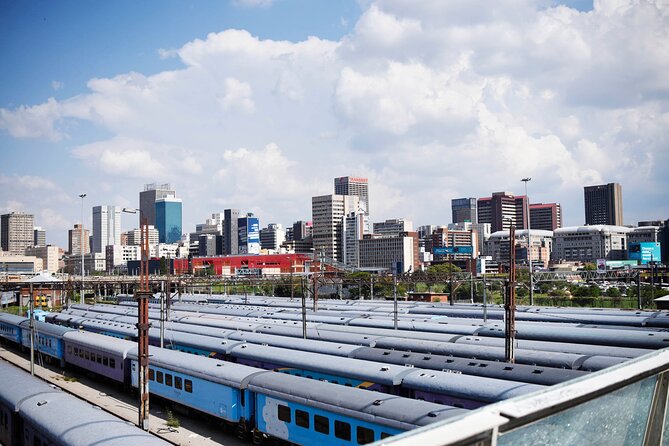
Mary Fitzgerald Square receives about 10 minutes. The square is often used for meetings and public gatherings, so it offers another way to read Johannesburg as a civic space rather than just a collection of historic buildings.
The stop is short, and its appeal depends on the guide’s timing and explanation. You may find it most useful as a pause between the heavier historical sites. It helps connect the city’s labor movements, political organizing, and public life.
The walk also gives you a chance to observe daily Jozi. One guide may point out music, street art, or local habits. Another may explain how a particular block has changed. The experience does not pretend the center is frozen in the past. You see people working, moving, meeting, and making use of streets that also carry difficult memories.
The Top of Africa and the wider view
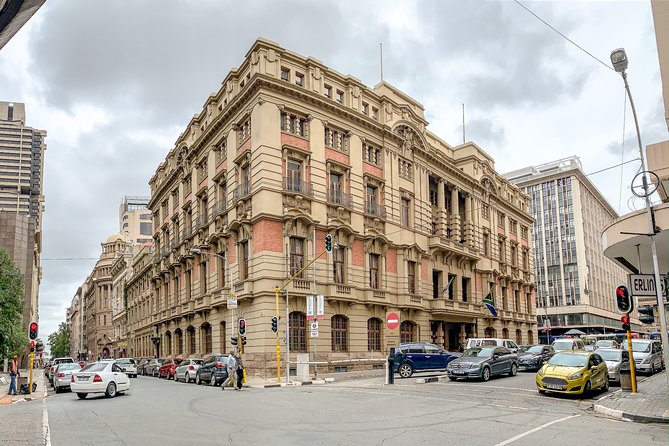
A key highlight is the view from the Top of Africa skyscraper. From above, Johannesburg makes more sense. You can see the scale of the city and gain a better idea of how the central district fits into the larger urban area.
I like this contrast between the close-up walk and the high view. On the pavement, you notice doorways, facades, squares, and people. At the Top of Africa, you step back and see a much larger city. It is a useful photographic stop, too.
The supplied route details do not give a separate duration for this visit, so I would treat it as part of the overall flow rather than plan on an extended observation deck stay. The exact access and timing should be confirmed when you book. That small uncertainty is worth noting if the view is your main reason for choosing the experience.
Getting to Maboneng for the braai
The walk finishes with lunch in the Maboneng Precinct, an arts-oriented part of Johannesburg known in this experience for music, crafts, public art, and local energy. The route may include a taxi or app-based ride from the central area. One guide arranged an Uber through Jewel City and Maboneng, while another used a taxi for a stretch that felt less suitable for walking.
That transport is not a flaw. It shows that this is a guided city experience, not a rigid march from one landmark to the next. Johannesburg’s center is large, and a sensible guide will adjust the route when a short ride makes more sense.
The meal is a South African braai, or barbecue, and it is a welcome social finish after the history-heavy walk. Chakalaka, a spicy vegetable relish, has been singled out as a tasty part of the meal. Plant-based choices are available, so you should mention your preference when booking or meeting the guide.
The lunch is included in the advertised experience as the final part of the day, but the supplied inclusions list specifically guarantees water, while additional items and costs are not included. I would clarify exactly what the meal covers and budget for drinks or extras. The food is valuable not only because it fills you up. It gives you a relaxed setting to keep asking questions and to connect the historical walk with present-day culture.
The guides make the difference
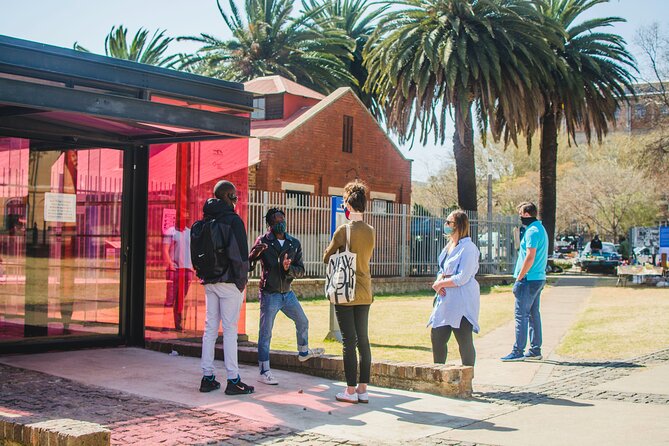
This experience uses different guides, so your day will not be identical to someone else’s. Mathapelo is praised for clear explanations, honest discussion of South African history, and a warm manner. Tebogo is described as fun, attentive to safety, and able to explain music and city life as well as historical sites.
Clement’s style is more relaxed, with the feel of strolling and talking with a friend. Kutlwano has shared frank opinions and later offered ideas for other things to see in Johannesburg. Sibongile has helped with transport and checked that a visitor arrived safely. Mulalo is associated with a strong explanation of Joburg and a lively local lunch.
I would ask questions freely. The best value here is not the number of buildings you pass. It is the guide’s ability to explain why a place matters, when to pause, and when to keep moving. Because the group maximum is 10, you have a fair chance to speak up without turning the walk into a private tour.
Safety, comfort, and practical limits
The guided format is the main safety advantage. You are not left to work out the central streets alone, and guides know when a taxi or Uber is the better choice. Several guides have helped people arrange their return transport, which is useful if you do not yet know Johannesburg well.
Still, do not treat a guide as a guarantee that every block is risk-free. Keep valuables out of sight, follow the guide’s directions, and stay with the group. The tour is designed for most people who can participate in a normal walking activity, but you should expect city pavements, pauses, and movement through busy public areas.
Wear comfortable shoes and bring sun protection. Water is included. The tour is not a private, highly polished sightseeing circuit, and that is both its appeal and its limit. You get real city texture, but also the signs of urban decline that some visitors may find sad or uncomfortable.
The ending needs a little attention. The meeting point is Nando’s Gandhi Square, while the stated end point is Constitution Hill Human Rights Precinct in Braamfontein, with lunch connected to the close of the tour. Since the route may include Maboneng and local transport, confirm the final drop-off plan before you start. This matters if you have a timed transfer or an evening reservation.
Is $45.19 good value?
At $45.19 per person, I see reasonable value for a small guided introduction to central Johannesburg. You are paying for about three hours of local interpretation, several historic locations, city views, safety-minded route decisions, water, and a braai lunch. A meal alone does not justify the price, but the combination makes it more useful than a simple walk.
The value is strongest for a first visit, especially if you feel unsure about exploring the city center alone. It is also good for anyone who wants South African history told through places rather than only through a formal museum.
The price is less compelling if you want a private guide, a long stop at every museum, or a fixed schedule with no route changes. Extra purchases are not included, and transport details can vary. I would also avoid booking it as your only Johannesburg experience. It gives you an important center-city introduction, but not a full picture of the metropolitan area.
Who should book this walk?
I would choose this tour if you want history, street scenes, local conversation, and a meal in one compact outing. It suits first-time visitors, solo travelers who prefer company in the city center, couples, and small families with older children who can manage a three-hour walk.
It is especially useful for people curious about apartheid-era history, Mandela and Tambo, labor migration, architecture, and present-day urban change. The tour does not smooth over the difficult parts. That honesty is one of its strengths.
I would think twice if you dislike uneven city conditions, prefer a quiet sightseeing environment, or need every stop to follow a precise timetable. The center can feel intense, and the guide may sensibly alter the route. You should come ready to pay attention, ask questions, and accept a little unpredictability.
FAQ
How long is the Johannesburg City Centre Walking Tour?
The experience lasts approximately three hours.
Where does the tour begin?
It begins outside Nando’s Gandhi Square, at Shop 180, corner of Fox and Gandhi Square, Metropolitan Building, Rissik Street, Marshalltown, Johannesburg.
Where does the tour end?
The stated end point is Constitution Hill Human Rights Precinct, 11 Kotze Street, Braamfontein, Johannesburg. Lunch is connected with the end of the tour.
What places are visited?
The route includes Main Street, the Workers Museum, Chancellor House, Mary Fitzgerald Square, Gandhi Square, and central Johannesburg. The experience also includes the Top of Africa and Maboneng Precinct among its highlights.
Is lunch included?
The experience ends with a South African braai lunch in the Maboneng Precinct, with plant-based options available. Additional items and costs are not included, so confirm what is covered in the meal.
Is water provided?
Yes. Water is included.
How many people can join?
The maximum group size is 10 people.
Is the tour suitable for most people?
Yes. Most people can participate, and the tour is near public transportation. You should still be comfortable with a walking activity through the city center.
Can I cancel for a full refund?
Yes, if you cancel at least 24 hours before the experience start time. Cancellations or changes made less than 24 hours in advance are not accepted for a refund.
Should you book it?
I would book this tour if Johannesburg feels hard to read from the outside. Its best features are the local guides, the honest city-centre context, the Workers Museum and Chancellor House, and the relaxed braai finish. The 4.9 rating from 80 reviews and 100 percent recommendation figure match the experience’s clear strengths, but you should still expect a real urban walk rather than a polished tourist bubble.
At $45.19, it is a sensible first-day choice for a small group. Book it if you want to see how Johannesburg lives, remembers, and changes at street level. Skip it only if you need a private, tightly timed route or would rather explore through museums and private transport.
Just added around Johannesburg
- Lion park★ 4.5 · 5 reviews
- Lesedi cultural village:★ 5.0 · 6 reviews
- Lesedi Cultural Village with lunch or dinner cultural food★ 4.6 · 9 reviews
- Lesedi Cultural Village Half-Day Tour★ 4.7 · 9 reviews
- Lesedi Cultural Village★ 4.9 · 4 reviews
- Kruger National Park – 5 Day Safari Tour★ 4.7 · 4 reviews
- From Johannesburg: Kruger National Park 4-Day Luxury Safari★ 4.8 · 9 reviews
- Kruger National Park – 4 Day Safari Tour★ 4.8 · 19 reviews
City Tours, compared.
Cape Town Hop-On Hop-Off City Tour with Optional Cruise
Read our review →
Johannesburg Hop-On Hop-Off City Tour with Soweto Option
Read our review →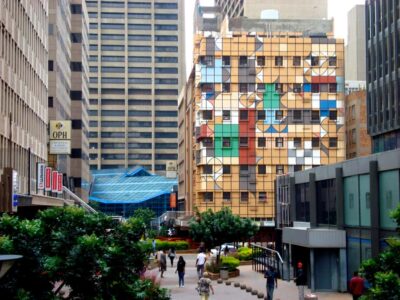
Jo’berg in 1 Day: Soweto, Apartheid Museum & City Tour
Read our review →
Cape Town City Pass: Save Over 50% on 80+ Top Attractions
Read our review →
Hop-On Hop-Off Bus, City Tour and Apartheid Museum
Read our review →

Browse the lists this tour appears in