
Reviewed · CITY TOURS
Johannesburg: City of Gold Walking Tour
Johannesburg reveals itself best at street level, and this four-hour tour puts you right into that mix. You’ll move from the creative Maboneng Precinct to Kwa Mai-Mai Traditional Market, the vast Collector’s Treasury bookstore, Gandhi Square, and downtown Main Street. I like the blend of local culture and major sights, plus the chance to use public transport with a guide who knows how to move around the city.
I also like the practical safety net. A local escort helps you visit places that can feel hard to judge on your own, while the walking format keeps the city from becoming a blur behind a car window. The main drawback is that you’ll walk a lot, and the Carlton Centre viewing stop has not always been open, so confirm that part before you book.
Key points at a glance
- Maboneng starting point: Meet at Curiocity, enjoy a fresh-brewed cappuccino, and begin in Johannesburg’s creative district.
- Kwa Mai-Mai Market: Browse traditional medicines, clothing, beadwork, walking sticks, and handmade souvenirs.
- Collector’s Treasury: Visit the largest second-hand bookstore in the Southern Hemisphere.
- Carlton Centre views: Ride to a 50-story building for wide city views, subject to current access.
- Gandhi Square: Learn about Mahatma Gandhi’s 21 years in South Africa and his time in Johannesburg.
- Public transport and walking: Expect an active outing with a local guide, not a coach tour.
Starting with coffee in Maboneng
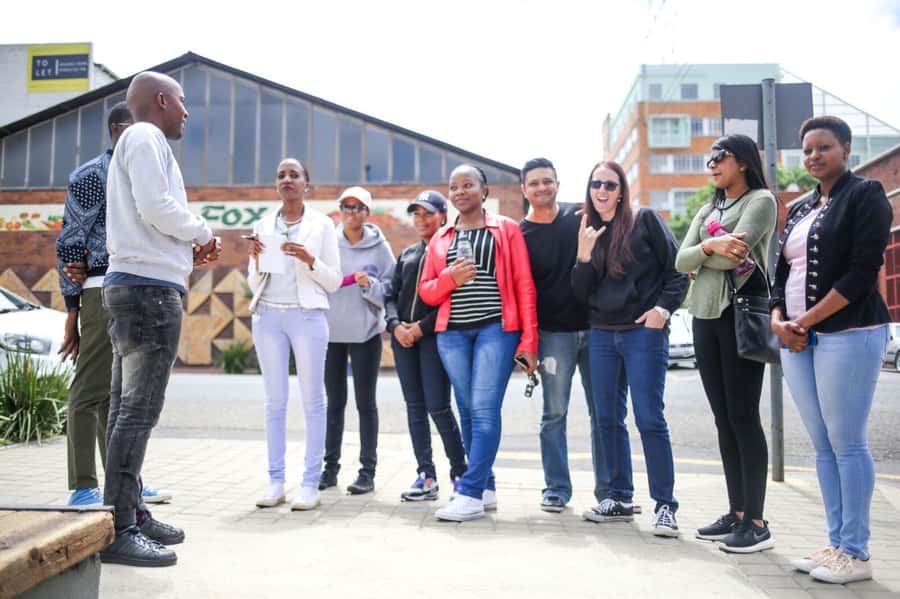
Your morning or afternoon begins at 302 Fox Street, home of Curiocity Johannesburg in the Maboneng Precinct. Arrive 15 minutes early. That gives you time to meet the guide, attend the safety briefing, and settle in with a cup of fresh-brewed cappuccino before setting off.
Maboneng means Place of Light. It has become a gathering point for urban artists, designers, and small businesses. The tour uses this neighborhood as more than a meeting point. You begin by seeing how Johannesburg’s old city areas have taken on new creative energy through art, design, and independent enterprise.
I like this opening because it gives you a gentle start before the walking picks up. You are not dropped straight into a long list of dates and names. Instead, the first section helps you notice the city’s street-level character.
The guide is central to the experience. One guide named Eco received especially warm praise for giving clear information, while another booking described the guide as friendly, street-smart, and good at explaining street art and city culture. Guides can vary, but the format depends on someone who can connect the places rather than simply point at them.
A few more Johannesburg trips to weigh up
- Soweto: Walking Tour with a Local Guide and Lunch
★ 4.9 · 648 reviews - Soweto Walking Tour with Lunch
★ 5.0 · 288 reviews - Johannesburg: Local Food Tasting Guided Walking Tour
★ 4.7 · 192 reviews
Walking through Johannesburg’s creative side
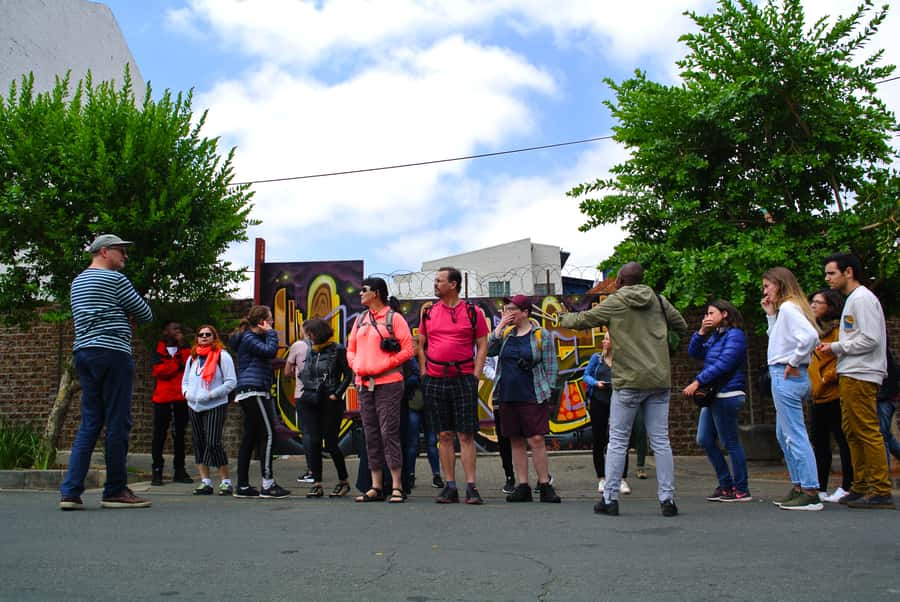
The Maboneng portion is best understood as an introduction to present-day Johannesburg. You will see the district’s public art, creative businesses, and changing urban identity while walking with someone who can add local context.
This is not a grand architectural tour in the traditional sense. The pleasure is in the combination of small details, street scenes, and the way artists and entrepreneurs have helped make the area a center for creative work. If you enjoy seeing how a city is being reshaped, this opening section gives you more than a quick photo stop.
Your guide also handles the practical side of walking through central Johannesburg. That matters here. You can concentrate on the surroundings instead of constantly wondering which direction to take or how the next transport connection works.
Wear proper walking shoes. A past participant described the outing as involving a lot of walking, so do not treat this as a relaxed ride with a few short stops. Bring a sun hat, sunscreen, and a camera. The tour is not suitable for people with limited mobility, and the operator also lists it as unsuitable for pregnant women.
Kwa Mai-Mai Market and useful souvenirs
The next major stop is Kwa Mai-Mai Traditional Market, one of Johannesburg’s oldest markets. This is where the tour shifts from creative urban culture to traditional goods and everyday commerce.
The stalls sell traditional medicines, ethnic clothing, beaded jewelry, walking sticks, and handicrafts. You might find a more distinctive keepsake here than in a standard city gift shop. If you want to buy something, this is a good point to carry a small amount of shopping money and leave room in your bag.
The market is valuable because it gives you a look at goods connected to local traditions, not just products made for sightseeing. Your guide can help explain what you are seeing and make the setting easier to read. You should still shop at your own pace and ask about prices before committing to a purchase.
Do not expect a quiet, polished retail experience. Markets can be visually busy, and the walking surface and crowd flow may require attention. That is part of the appeal, but it also reinforces the need for comfortable shoes and awareness of your belongings.
I would place this stop high on the list for anyone who likes food markets, craft stalls, and practical souvenirs. If you prefer museums and formal exhibitions, you may find the market less rewarding than the later historical stops.
Collector’s Treasury, a paradise for book hunters
The tour then heads to Collector’s Treasury, described as the largest second-hand bookstore in the Southern Hemisphere. Even if you are not planning to buy a book, the scale of the collection makes this an unusual Johannesburg stop.
A large used bookstore offers a different kind of city experience. You can browse at leisure, look for old South African titles, or simply enjoy the feeling of a place that has grown around books rather than souvenirs. The stop also breaks up the outdoor walking with something quieter and more focused.
The time available may affect how deeply you can browse. This is a four-hour tour with several stops, so you should not expect an extended shopping session. If you see a book you want, make your decision without assuming you will have another chance later.
For me, Collector’s Treasury is one of the tour’s most appealing surprises. It is specific to the city, easy to remember, and different from the usual list of monuments. It also gives the day a nice change of pace after the market.
Same country, a completely different kind of day:
- From Johannesburg: Pilanesberg Nature Reserve Game Safari
★ 4.8 · 1,327 reviews - Johannesburg: Hop-On Hop-Off Bus with Optional Soweto Tour
★ 4.6 · 985 reviews - Soweto /Johannesburg and Apartheid Museum Guided Full Day Tour
★ 5.0 · 932 reviews - Johannesburg Hop-On Hop-Off City Tour with Soweto Option
★ 4.5 · 768 reviews
Carlton Centre and the city from above
After the bookstore, you take a shuttle to the Carlton Centre. The building is a 50-story skyscraper and offers the tour’s broad city view from above.
This stop helps you understand Johannesburg’s size and layout. After walking through individual streets and neighborhoods, you can look across the city and see how those pieces fit together. The view is especially useful if you are still trying to get your bearings during a first visit.
There is one important caution. Access to the viewing area has previously been unavailable for an extended period, even though the stop was part of the advertised experience. Check the current status before booking, and do not assume the city view is guaranteed on your date.
That issue affects the tour’s value. If the Carlton Centre is open, it adds a memorable visual finish to the central-city section. If it is closed, the guide may still take you to the building, but you will lose one of the experience’s biggest advertised payoffs.
The $54 price needs to be judged with that in mind. You are paying for a four-hour guided experience, local orientation, help with public transport, and access to several distinct parts of Johannesburg. You are not paying only for admission tickets. Still, the value feels stronger when the Carlton Centre viewing area is operating and weaker when it is not.
Gandhi Square and Johannesburg’s personal history
Gandhi Square provides the tour’s clearest historical focus. The square is named after Mahatma Gandhi, who spent 21 years in South Africa, and the guide explains his time in Johannesburg.
This stop works because it connects a well-known international figure with a specific place. Rather than treating Gandhi as a distant name in a textbook, the tour looks at the period he spent in South Africa and the city where part of his public life developed.
Your guide’s explanation is important here. The stop is relatively compact, so the value comes from the story and the local setting rather than from a long museum visit. Listen for how the guide connects the square to Johannesburg’s wider history and changing identity.
I would especially recommend this part to first-time visitors who want historical context but do not want a full-day museum program. It gives you a clear subject to focus on while keeping the tour moving.
Main Street, Chancellor’s House, and Mandela’s boxing statue
The final walk takes you along downtown Main Street. This section ties together the city’s public art, political memory, and historic buildings.
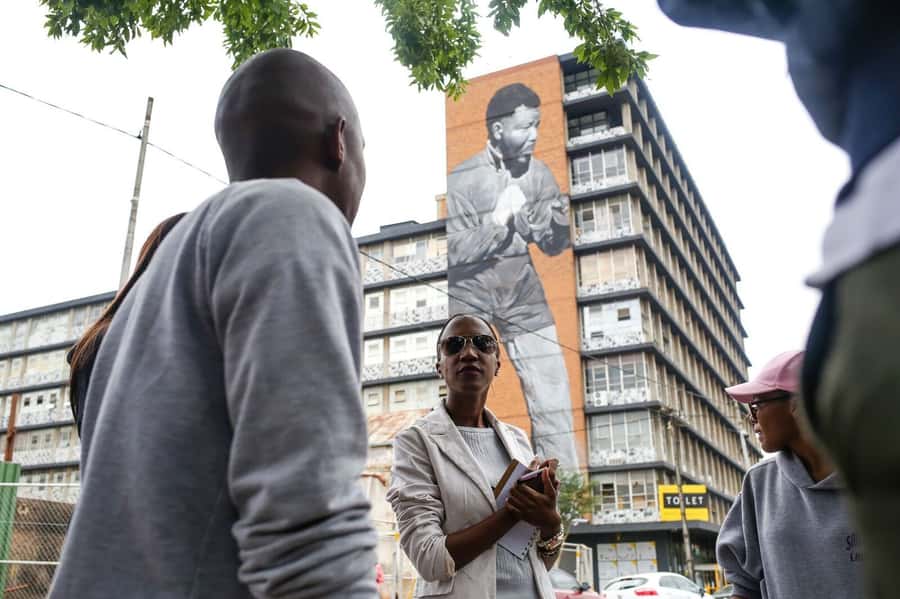
You pass Chancellor’s House, then see the Shadow Boxing statue, a monumental sculpture showing Nelson Mandela as a young boxer. The statue offers a striking image of Mandela before his years as president, and it gives the walk a more personal ending than a generic city-center viewpoint.
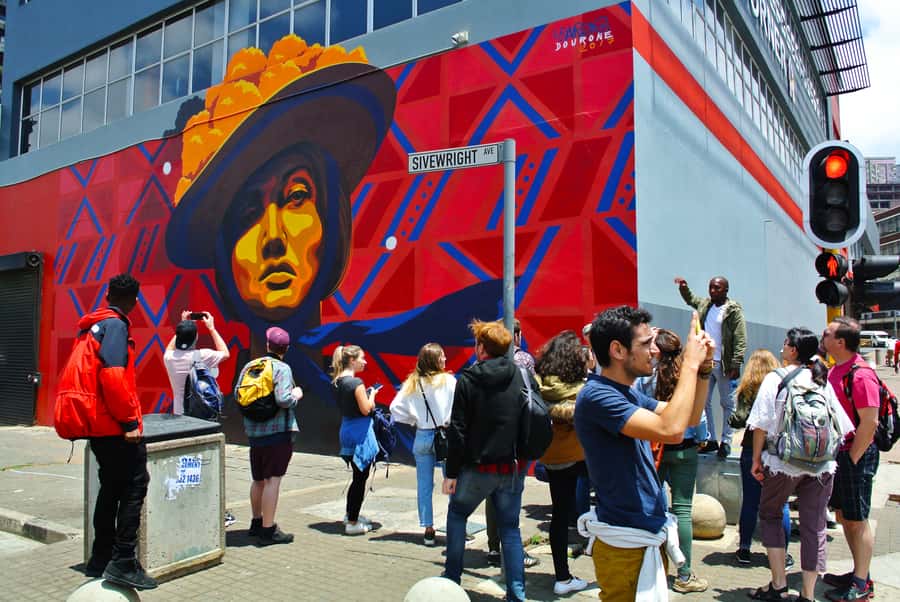
This is also where the tour’s focus on street art and city culture pays off. One especially positive account of the experience praised the way the guide highlighted art as well as urban life. You are encouraged to look at the city as a living place, not just a collection of official attractions.
The route ends back at 302 Fox Street. Because the tour combines walking with public transport, the return is part of the experience rather than a simple transfer to a waiting vehicle. You should plan the rest of your day with a little flexibility in case the walking pace or city transport takes longer than expected.
How the public transport changes the experience
This is not a private-car sightseeing tour. You walk between places and use safe public transport for part of the route, including a shuttle to the Carlton Centre.
That format has two clear benefits. First, you see more of the city at street level. Second, you learn how central Johannesburg connects, which can make the city feel less abstract during the rest of your stay.
The tradeoff is comfort and predictability. You will not spend the day seated in an air-conditioned vehicle, and public transport can make timing less exact. The route also demands more energy than the short stop-and-go pattern of a coach tour.
A local escort makes a practical difference. A booking account described feeling secure in areas where going alone might have felt uncomfortable. That does not mean you should switch off your normal city awareness, but it does mean the tour can give you a more confident first look at central Johannesburg.
Is $54 a fair price?
At $54 per person, this is not the cheapest way to see Johannesburg. The fee covers the expert English-speaking guide, but food, drinks, and hotel pickup and drop-off are not included.
The price makes the most sense if you value orientation and local explanation. In four hours, you cover Maboneng, Kwa Mai-Mai Market, Collector’s Treasury, the Carlton Centre, Gandhi Square, and Main Street. Reaching all of those places independently would require planning, transport decisions, and a willingness to judge unfamiliar areas as you go.
The value is less convincing if you only want a high viewpoint and a few photographs. The Carlton Centre access issue matters, and a closed viewing area would remove one of the tour’s strongest visual moments.
I would also factor in the walking. You are paying for an active introduction to the city, not a restful outing. If that sounds appealing, the combination of history, shopping, books, public art, and city views gives the fee a reasonable purpose.
Who should book this Johannesburg walk?
This tour suits first-time visitors who want a quick but broad introduction to central Johannesburg. It is particularly useful if you like markets, street art, local history, independent bookstores, and seeing a city through its everyday streets.
It also suits visitors who would rather not navigate public transport and central neighborhoods alone. The guide’s local knowledge and street awareness are a major part of what you are buying.
You may want another option if you have limited mobility, are pregnant, dislike extended walking, or prefer a private vehicle. It is also not ideal if you need a fully fixed schedule, since walking and public transport can affect the pace.
Book only after checking the current Carlton Centre viewing situation. If that stop is open, the tour has a satisfying range of experiences. If it is closed, decide if the market, bookstore, Gandhi Square, street art, and guided city orientation still justify the cost for you.
Practical details before you go
Meet at Curiocity Johannesburg, 302 Fox Street, in the Maboneng Precinct. Arrive 15 minutes before the start time for the meeting and safety briefing.
The tour lasts four hours and is conducted in English by a live guide. Food and drinks are not included, though the experience begins with a cappuccino.
Wear comfortable shoes and bring sun protection. A camera is useful, especially for the public art, market stalls, city views, and Shadow Boxing statue.
Free cancellation is available up to 24 hours before the activity for a full refund. You can also reserve now and pay later, which is useful when your Johannesburg schedule is still changing.
Should you book the City of Gold Walking Tour?
I would book this tour if you want a guided first look at Johannesburg’s central districts and enjoy mixing major sights with places you might not find on your own. The strongest parts are the market, Collector’s Treasury, Gandhi Square, and the street-level look at Maboneng and Main Street.
I would hesitate only if the Carlton Centre viewing area remains closed, the price feels high for a walking tour, or four hours on foot sounds tiring. Check that one key detail before paying. If the view is available and you like active city touring, this is a smart way to get a grounded introduction to Johannesburg.
FAQ
Where does the Johannesburg City of Gold Walking Tour begin?
The tour begins at CURIOCITY Johannesburg, located at 302 Fox Street in the Maboneng Precinct.
How long does the tour last?
The activity lasts four hours and returns to 302 Fox Street.
What language is the tour conducted in?
The live guided tour is conducted in English.
Is hotel pickup included?
No. Hotel pickup and drop-off are not included. You meet the guide at Curiocity Johannesburg.
Is the tour suitable for people with limited mobility?
No. The tour is not recommended for people with limited mobility and is listed as unsuitable for people with mobility impairments.
What should I bring?
Bring comfortable shoes, a sun hat, sunscreen, and a camera. Food and drinks are not included.
Just added around Johannesburg
- Lion park★ 4.5 · 5 reviews
- Lesedi cultural village:★ 5.0 · 6 reviews
- Lesedi Cultural Village with lunch or dinner cultural food★ 4.6 · 9 reviews
- Lesedi Cultural Village Half-Day Tour★ 4.7 · 9 reviews
- Lesedi Cultural Village★ 4.9 · 4 reviews
- Kruger National Park – 5 Day Safari Tour★ 4.7 · 4 reviews
- From Johannesburg: Kruger National Park 4-Day Luxury Safari★ 4.8 · 9 reviews
- Kruger National Park – 4 Day Safari Tour★ 4.8 · 19 reviews
City Tours, compared.
Cape Town Hop-On Hop-Off City Tour with Optional Cruise
Read our review →
Johannesburg Hop-On Hop-Off City Tour with Soweto Option
Read our review →
Jo’berg in 1 Day: Soweto, Apartheid Museum & City Tour
Read our review →
Cape Town City Pass: Save Over 50% on 80+ Top Attractions
Read our review →
Hop-On Hop-Off Bus, City Tour and Apartheid Museum
Read our review →

Browse the lists this tour appears in