
Reviewed · HERMANUS WHALE WATCHING
Hermanus: Whale and Dolphin Watching Boat Trip
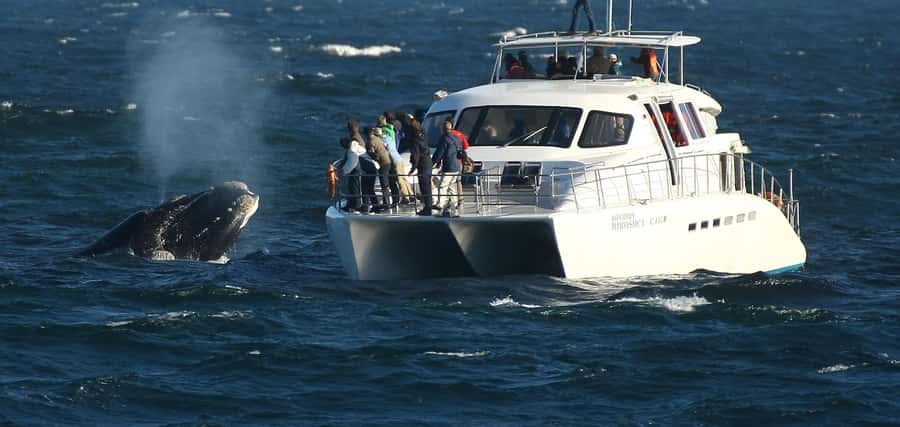
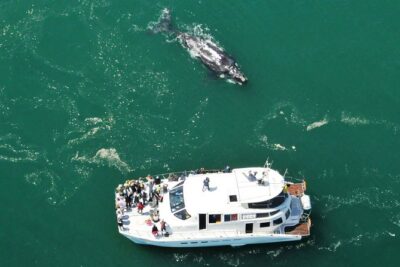
Hermanus puts you on the water in search of southern right whales, with dolphins often joining the show. In good conditions, whales may approach the catamaran closely, sometimes with calves beside them, while the guide explains what you are seeing as it happens.
I like the purpose-built catamaran, which gives you room to spread out and find a good viewing spot. I also like the serious, friendly crew, especially guides such as Ken, Jacques, and David, who combine whale facts with sharp spotting skills. The main drawback is simple: wildlife is wild. Late in the season, you may see hundreds of dolphins and no whales at all, and the ride can be bouncy.
Key points to know before you go
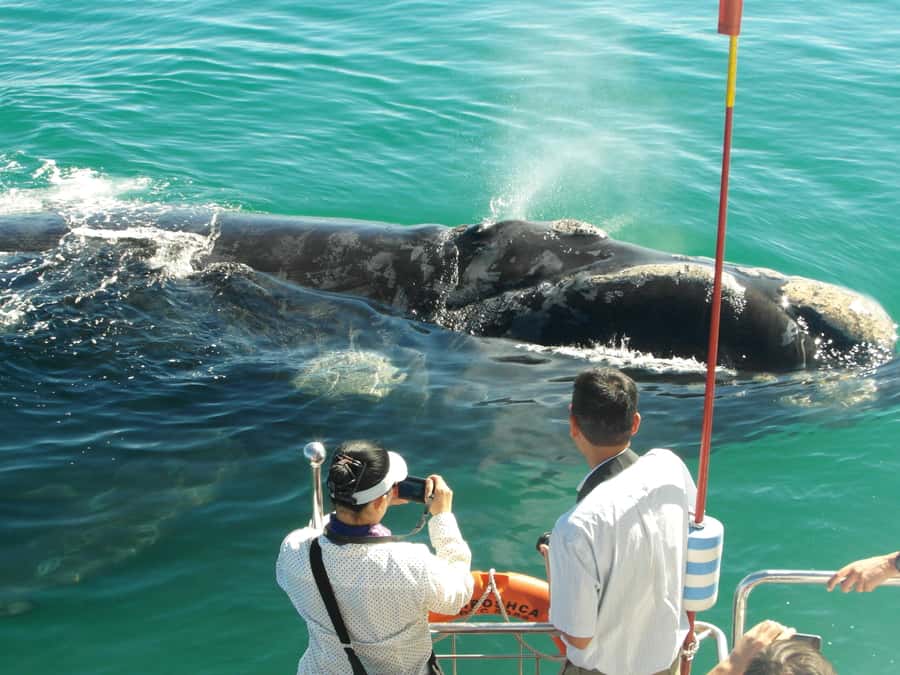
- Whales, dolphins, and seals: Seasonal southern right and humpback whales share the bay with year-round Bryde’s whales and dolphins, while seals may appear during the cruise.
- Two hours on a large catamaran: The vessel offers several viewing areas, though the best rail position can become crowded.
- Guides who interpret the action: The whale specialist points out behavior, explains the animals, and helps you understand what is happening beyond simply spotting a fin.
- Refreshments before and during the trip: Tea, coffee, cupcakes, fizzy drinks, crisps, and other light refreshments may be offered as part of the outing.
- Best timing matters: The main southern right whale season runs roughly from June through December, with especially strong sightings often reported from late winter into spring.
- Sea conditions are part of the deal: Wear a windbreaker, choose flat shoes, and take motion sickness medicine in advance if you need it.
Why Hermanus is such a strong whale-watching base
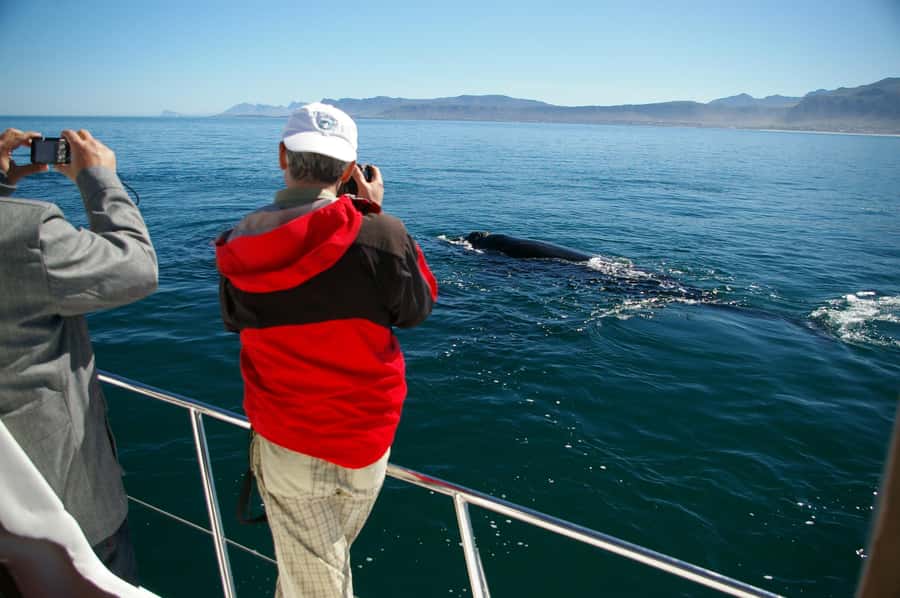
Hermanus is known as South Africa’s Whale Capital for good reason. The town sits beside Walker Bay, where marine mammals come close enough to be seen from shore and, during the right months, from a boat.
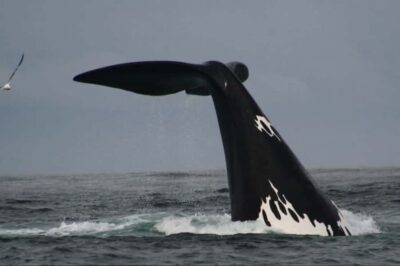
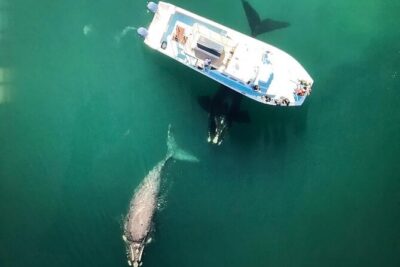
A cruise gives you a different angle from the famous coastal viewpoints. From the water, you can watch a whale surface, roll, slap its tail, or swim beneath the boat. The view also changes quickly. One moment you may be scanning empty water, and the next a southern right whale and calf can appear beside the catamaran.
The boat trip does not guarantee a sighting, and no ethical operator can promise one. That is worth keeping clear in your mind before paying $98 per person. You are buying time in a productive marine area, skilled searching, interpretation, and a comfortable boat, not a scheduled whale appearance.
The experience is strongest from June to December, when southern right whales visit the coast. Humpback whales may also pass through seasonally. Bryde’s whales and dolphins can be seen throughout the year, although sightings still depend on weather, sea conditions, and animal behavior.
More Hermanus Whale Watching in Hermanus
- Hermanus: Boat Based Whale Watching Experience
★ 4.4 · 1,180 reviews - Boat Based Whale Watching from Hermanus
★ 4.5 · 205 reviews - Whale Watching Walking Tours (Land-Based) – from JUNE 2025
★ 5.0 · 88 reviews
Checking in at the Whale Shack
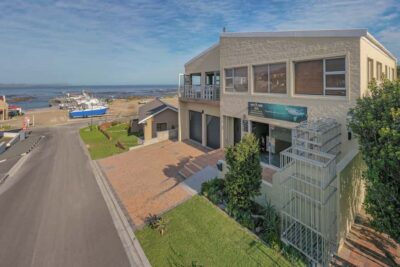
You check in 30 minutes before departure at Southern Right Charters’ welcome center, known as the Whale Shack, on the lower level of Hermanus New Harbour. Build this half hour into your day. Arriving late could mean rushing through boarding or missing the departure.
The harbor entrance carries a small fee of R5, payable when you enter. That charge is not included in the tour price, so keep a few rand available.
The welcome area is part of the experience rather than a forgettable waiting room. Before some departures, the team serves tea, coffee, and cupcakes. A short introduction can help you understand the different whale species before you step aboard. Guide Ken has been praised for his opening explanation, while guides such as Jacques and David are noted for keeping the interpretation going once the boat is underway.
I like this early briefing because it changes the way you look at the sea. You are not just waiting for a large animal to break the surface. You are learning to watch for blows, backs, tails, calves, and changes in movement.
Getting aboard the purpose-built catamaran
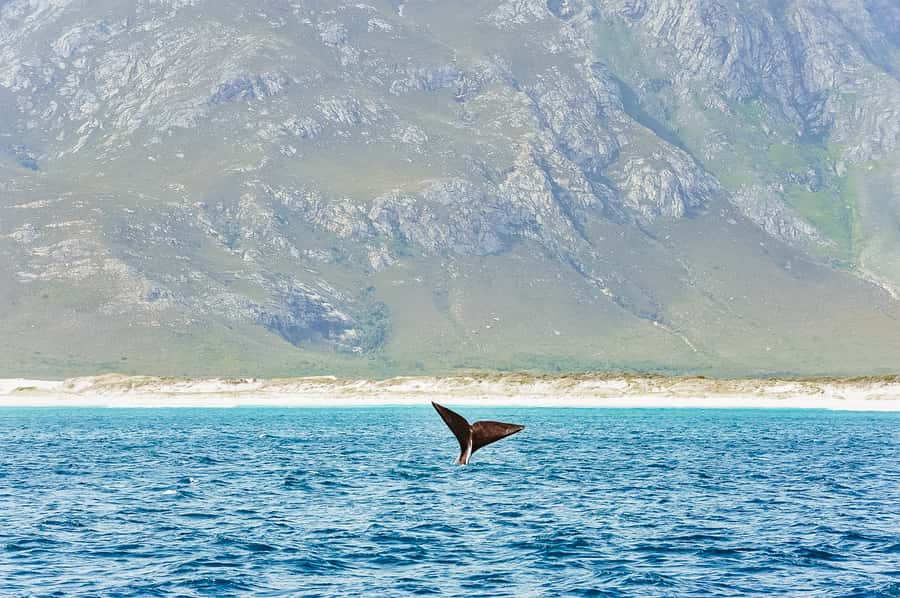
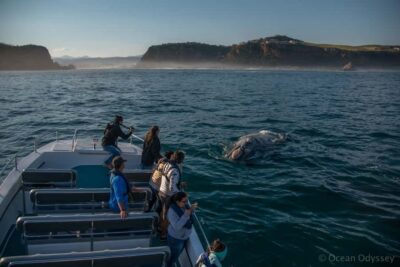
The vessel is a purpose-built catamaran designed for passenger comfort and viewing. That matters more than it may sound. Whale watching involves plenty of standing, scanning, and waiting, and a cramped boat can turn a good sighting into a fight for elbow room.
This catamaran has several places where you can position yourself. Some people head straight for the front, while others prefer a side where they can watch the water without constantly looking over shoulders. The boat is large enough that a sizeable group does not necessarily feel packed together.
There is one practical catch. The front deck can become occupied by people who stay there for much of the outing, leaving others with less room at the prime viewing edge. You may need to move around and politely share positions rather than expect one perfect viewing spot for the entire trip.
Flat shoes are the sensible choice. Wear warm, weather-appropriate layers and bring a windbreaker, even if the harbor feels mild. Once the boat moves into open water, wind can make the temperature feel much lower.
Tripods and binoculars are not advised. A camera or phone is easier to handle, particularly when the boat is moving and the animals surface without warning.
What the two-hour cruise is like
Once the boat leaves New Harbour, the crew searches the coastline and waters of Walker Bay. The exact route changes according to sea conditions and where marine life has been seen. This is not a fixed sightseeing circuit with a series of guaranteed stops.
The first part of the trip may involve scanning the water while the guide explains the region and its animals. This waiting is useful, but you should know that whale watching is not constant action. The guide and skipper work together, looking for movement and choosing where to spend time.
When a whale is found, the mood changes quickly. The guide identifies the animal and explains its behavior while the crew gives you time to watch and take photographs. The goal is not simply to race from one sighting to another. A good encounter can mean staying with an animal as it surfaces, swims, or approaches the boat.
The strongest sightings reported on this trip include southern right whales swimming close alongside the catamaran, mothers with calves, groups of four whales, and whales breaching in shallow water. A southern right whale and calf have even been seen moving with a large pod of dolphins.
You might also find yourself surrounded by dolphins. Groups ranging from around 100 to roughly 300 have been seen, sometimes swimming toward the whales or alongside the boat. Dolphins are not a consolation prize. They are fast, social, and often easier to follow than whales, creating some of the liveliest moments of the cruise.
Bryde’s whales add another possibility, particularly outside the main southern right season. Seals have also appeared during trips. Seeing several types of marine life in two hours is possible, but it should be treated as luck rather than a promise.
More Hermanus Whale Watching in South Africa:
- From Hermanus or Cape Town: Shark Cage Diving Experience
★ 4.7 · 684 reviews - From Cape Town: Hermanus Whale Watching Boat Trip
★ 4.4 · 378 reviews - Plettenberg Bay: Whale Watching Boat Cruise
★ 4.4 · 362 reviews - Whale Watching from Gansbaai
★ 5.0 · 327 reviews
The guides make the sightings easier to understand
The guide is more than a person who points at the horizon. A whale specialist explains the animals’ behavior while it is happening, which gives the cruise an educational purpose.
Ken has been singled out for a clear introduction to Hermanus whales. Jacques has been praised for his explanations and calm handling of the trip. David is known for spotting small movements around the boat and identifying mothers and calves. Josh, another guide associated with the operator, has been described as passionate and well informed.
That range of guide experience is important because whale watching depends on fast observation. A trained eye may notice a distant blow or a change in the water before most passengers do. Once the guide calls it out, you have a chance to follow the movement instead of staring at the wrong patch of sea.
The best interpretation also helps you keep your expectations in check. You learn to appreciate a whale surfacing briefly, even if it does not breach beside the boat. You also get a clearer sense of why the crew may pause, change direction, or leave an animal alone.
Several trips have been praised for keeping a respectful distance and allowing whales to approach rather than chasing them. That conservation-minded approach may mean you do not always get the closest possible camera angle, but it is the right way to handle wild animals.
Refreshments, crew support, and onboard comfort
Light refreshments are included. Depending on the departure, you may receive tea, coffee, cupcakes, crisps, water, or soft drinks. These are modest additions, not a meal, but they are welcome during a two-hour outing in cool air.
The crew is active throughout the trip. They help passengers find better viewing positions, point out wildlife, and assist with practical needs. One particularly useful example involved a passenger who struggled to stand. The staff moved him to an area where he could still see the whales.
That kind of help matters more than polished sales talk. Boat decks are not easy for everyone, and a considerate crew can make the difference between watching the action and missing it.
Safety is given serious attention. Children of all ages are allowed, but every child under 12 must wear a life jacket for the full time aboard and remain under adult supervision. Infants are included in that rule. For children under two, the jacket may be uncomfortable, and motion sickness syrup is strongly advised in the supplied guidance.
The vessel is not wheelchair accessible. Non-folding and electric wheelchairs are not permitted, and baby strollers and prams cannot come aboard. Drones are also prohibited.
Whale season, dolphin season, and the risk of a quiet day
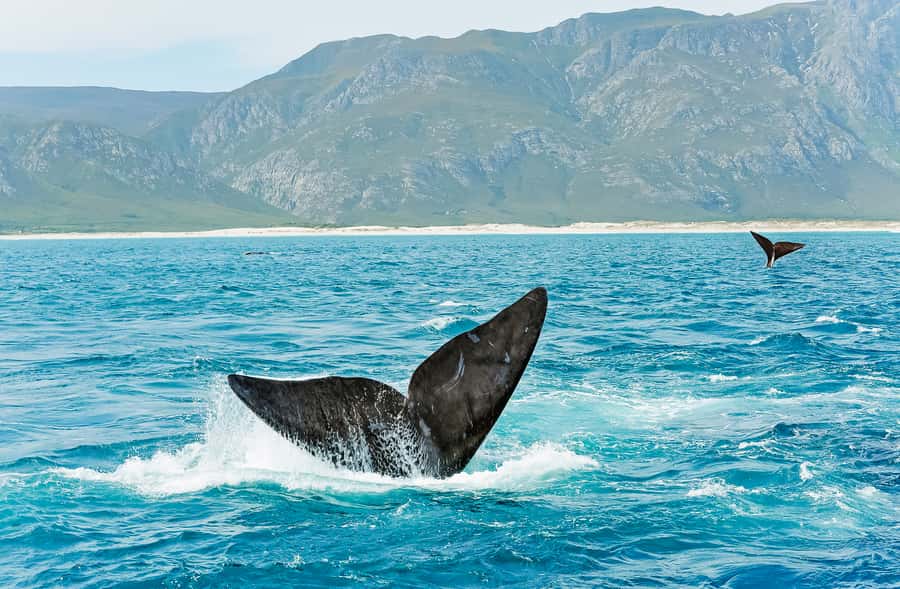
If whales are your main goal, plan around the strongest part of the season rather than treating June through December as equally reliable. Southern right whales are the headline attraction, and sightings of mothers with newborn calves have been especially memorable in July, August, September, and October.
Spring departures have produced repeated sightings of several whales, calves, and dolphins. Sunrise trips can be especially appealing because the early light adds drama to the coastline and the water may be calm. But an early start is no guarantee of better wildlife. It is simply a beautiful option when the schedule suits you.
By late November and early December, the southern right season may be winding down. A trip at that time can still produce huge dolphin pods, seals, or a late whale sighting. It can also produce nothing more than a boat ride. One late-season departure resulted in no wildlife sightings, and the operator provided a 50 percent refund. That response is worth noting, but it does not recover the time and driving expense for someone coming a long way from Cape Town.
If you are making a special trip from Cape Town, think carefully about the wildlife risk. Driving nearly 200 kilometers each way for a two-hour cruise is a large commitment if whales are the only reason you are going. Hermanus itself has coastal viewing opportunities, so adding a boat trip to a broader visit makes better sense than building an entire day around a guaranteed sighting.
Seasickness and the ride back to harbor
The sea can be calm and sunny, or it can become uncomfortable on the return journey. A July departure was described as smooth on the way out and bouncy on the way back. Other passengers have needed help with seasickness, and the crew assisted them.
If you know you are prone to motion sickness, take tablets in advance according to the packet instructions. Do not wait until the boat is already moving. The same guidance recommends motion sickness syrup for infants, though young children must also cope with the required life jacket.
Wear shoes with good grip and avoid high heels or unstable footwear. Keep your camera secure and use a strap if possible. You will want both hands available when the crew spots a whale.
The catamaran offers a more stable platform than a small open boat, but it is still a boat in the ocean. If you need a completely steady sightseeing experience, this outing may not suit you.
Is the $98 price good value?
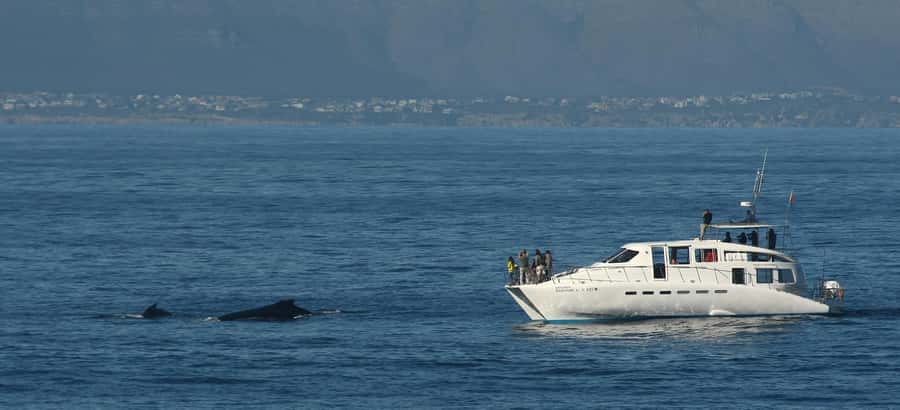
At $98 per person, this is not a cheap add-on. The price makes the most sense if you value the specialist guide, the larger catamaran, the crew support, and the chance to see several kinds of marine life in one outing.
Tea, coffee, and light snacks are included, along with the two-hour cruise and live English-language guide. The crew’s safety work and wildlife interpretation also add value, particularly for first-time whale watchers who would otherwise miss subtle behavior.
The optional movie and short film are extra. An aerial or drone video of the boat and wildlife can be purchased afterward, with one price mentioned at R440. Some people find the footage a memorable souvenir, while others consider it expensive after already paying for the cruise. I would decide only after seeing what the finished video contains.
The value drops if you travel a long distance solely for whales and depart near the end of the season. The operator may offer a partial refund after a completely empty trip, but that cannot replace your fuel, time, or other plans.
For a visitor already staying in or near Hermanus during peak whale months, the calculation is better. You have a serious chance of excellent sightings, a comfortable boat, and a guide who can turn a simple animal encounter into something you understand.
Who should book this boat trip?
I would recommend it to families with children old enough to manage a life jacket, couples looking for a memorable coastal outing, photographers who can work without a tripod, and anyone who wants more context than a shoreline viewing point provides.
It is also a good fit if you care about responsible wildlife watching. The crew has been praised for giving animals space and for contributing marine-life information to international agencies. You cannot control what appears, but you can choose an operator that treats the animals as wild creatures rather than stage performers.
I would think twice if you use a wheelchair, need a stroller, dislike boats, or are highly sensitive to motion. I would also avoid making a long, expensive day trip from Cape Town in late season if a whale sighting is essential.
Book with flexible plans if possible. The activity allows cancellation up to 24 hours before departure for a full refund, and you can reserve now and pay later. Weather can force a change, as shown by a rescheduled trip that was handled with good communication.
Should you book Southern Right Charters?
Yes, if you are in Hermanus during the main whale months and accept that nature sets the timetable. The combination of a large catamaran, sharp spotters, practical crew, refreshments, and strong dolphin and whale sightings makes this a worthwhile outing.
Choose a peak-season departure, arrive 30 minutes early, and bring a windbreaker and motion sickness tablets if needed. If your trip falls late in the season, book for the broader marine experience rather than a guaranteed whale. You may come away with whales, calves, dolphins, seals, and dramatic photographs. You may also spend two quiet hours at sea, which is the honest risk behind every wildlife cruise.
FAQ
How long is the Hermanus whale and dolphin boat trip?
The cruise lasts two hours. Check the available departure times when booking.
Where do I meet the boat?
Check in 30 minutes before departure at Southern Right Charters’ Whale Shack welcome center on the lower level of Hermanus New Harbour.
What animals might I see?
The cruise looks for seasonal southern right and humpback whales, plus year-round Bryde’s whales and dolphins. Seals may also be seen.
Are refreshments included?
Yes. Light refreshments and crisps are included. Tea, coffee, cupcakes, water, and soft drinks may be served at different points around the outing.
Is the boat wheelchair accessible?
No. The vessel is not wheelchair accessible, and non-folding or electric wheelchairs are not permitted. Baby strollers and prams are also not allowed.
What should I wear and bring?
Wear weather-appropriate clothing, a windbreaker, and sensible flat shoes. Bring a camera, but leave tripods and binoculars at home. If you are prone to seasickness, take tablets before departure according to the packet instructions.
More Dolphin Watching in South Africa
- Cape Town: Dolphin & Ocean Wildlife Kayaking Adventure ⚓️
★ 5.0 · 57 reviews - Durban: Durban: Whale and Dolphin Watching Boat Tour
★ 4.7 · 45 reviews
More Whale Watching in South Africa
- Whale, Dolphin & Penguin Island Cruise
★ 5.0 · 687 reviews - Knysna: Close Encounter Whale Watching Tour by Boat
★ 4.6 · 207 reviews - From Cape Town: Full Day Guided Hermanus and Whale Tour
★ 5.0 · 155 reviews - Gansbaai: Whale Watching Trip by Boat
★ 4.7 · 127 reviews
Just added around South Africa
- Lion’s Head Hike: Cape Town – Sunrise or Sunset Hike★ 5.0 · 29 reviews
- Lion’s Head Sunrise or Sunset Hike + Hotel Pick-Up★ 5.0 · 24 reviews
- Lion Park Tour in Open Safari Vehicle★ 5.0 · 6 reviews
- Lion’s Head: Hike with a registered hiking guide★ 5.0 · 3 reviews
- 4×4 into Lesotho From Underberg – Horse Ride / Village Life★ 4.8 · 18 reviews
- Lesotho: Sani Pass Scenic Day Trip w/ Village Visit & Lunch★ 5.0 · 3 reviews
- Lion park★ 4.5 · 5 reviews
- Lesedi Cultural Village★ 4.9 · 14 reviews
Hermanus Whale Watching, compared.
From Hermanus or Cape Town: Shark Cage Diving Experience
Read our review →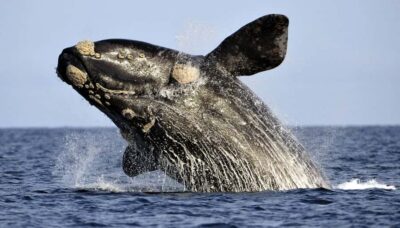
Browse the lists this tour appears in