
Reviewed · WHALE WATCHING
Whale, Dolphin & Penguin Island Cruise
Algoa Bay gives you a rare wildlife show from the water: humpback whales passing offshore, dolphins racing the bow, and African penguins gathering around St. Croix Island. This is a small-group cruise, capped at 20 people, with a slower pace that leaves room for questions and careful wildlife watching.
I like two things right away. The crew combines practical boat skills with serious knowledge of the bay, and the tour supports tree planting to balance its carbon footprint. I also like that it runs only once a day, which keeps the outing focused rather than rushed. The main consideration is simple: wildlife is wild, and whale sightings are seasonal and never guaranteed.
Key points to know before you book
- Humpback whales visit from June to early December, with southern right whales most likely close to shore from July through September.
- Bottlenose dolphins can appear all year, often in groups of 10 to 400 and sometimes alongside the boat.
- St. Croix Island is the penguin stop, though the African penguin population has suffered a steep decline.
- The boat carries no more than 20 people, making it easier to hear the guide and get a clear view.
- The four-hour trip leaves at 8am from Nelson Mandela Bay Yacht Club at Dom Pedro Jetty.
- Weather and minimum numbers matter, so a poor-weather cancellation brings a new date or full refund.
A morning on Algoa Bay with Raggy Charters
The cruise begins at 8am at the Nelson Mandela Bay Yacht Club, inside Port Elizabeth Harbour in central Gqeberha. After a short safety briefing, you board a twin-engine catamaran and head into Algoa Bay.
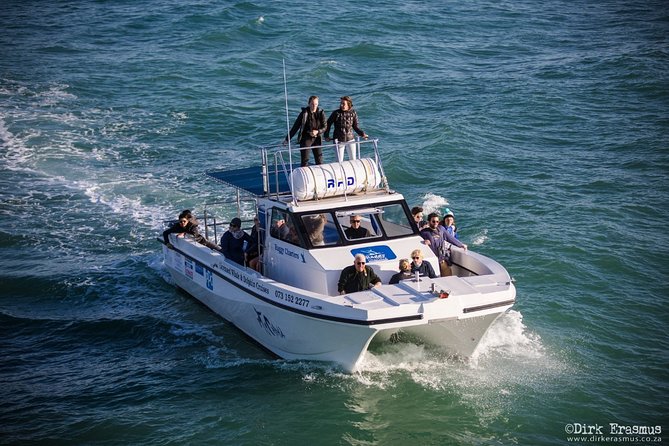
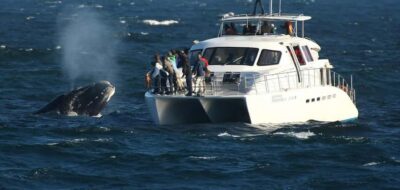
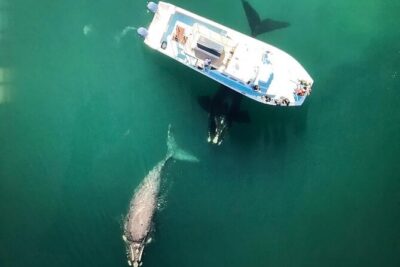
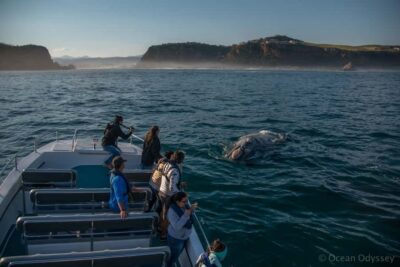
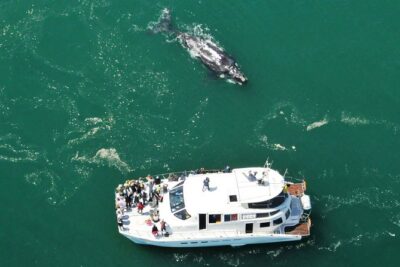
The boat is small enough to feel personal but has twin engines for added security on open water. The group limit of 20 matters here. You are not packed into a large sightseeing vessel, and the crew can spend time turning the boat so people on different sides get a fair chance at a sighting.
The pace is deliberately measured. This is not a high-speed ride designed to cover as much water as possible. The skipper slows down around wildlife, watches animal behavior, and gives the guide time to explain what you are seeing.
That approach also makes the trip more comfortable for photography. A whale’s back may appear for only a few seconds, and a dolphin can change direction without warning. A calm boat and a crew that communicates clearly give you a better chance of enjoying the moment instead of simply chasing it.
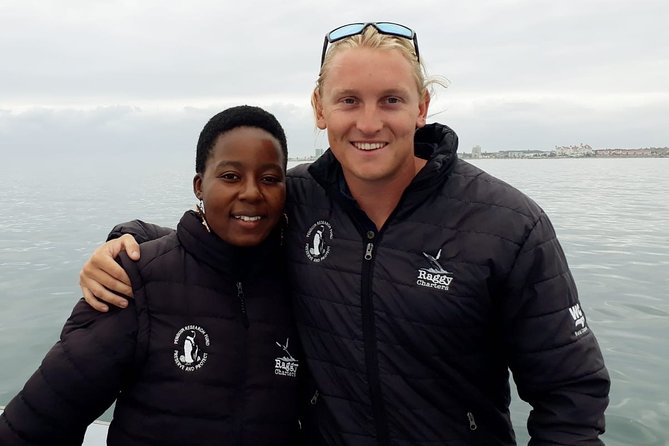
The four-person crew has been praised for being friendly, attentive, and alert to safety. Jake is one of the guides associated with the trip, and his talks focus on the animals, their behavior, and the pressures facing Algoa Bay. The crew also handles rougher conditions with care, though you should remember that a four-hour ocean cruise can still feel lively when the water turns choppy.
A few more Port Elizabeth trips to weigh up
- Hermanus: Boat Based Whale Watching Experience
★ 4.4 · 1,180 reviews - Hermanus: Whale and Dolphin Watching Boat Trip
★ 4.6 · 807 reviews - From Cape Town: Hermanus Whale Watching Boat Trip
★ 4.4 · 378 reviews
Whale season from June through early December
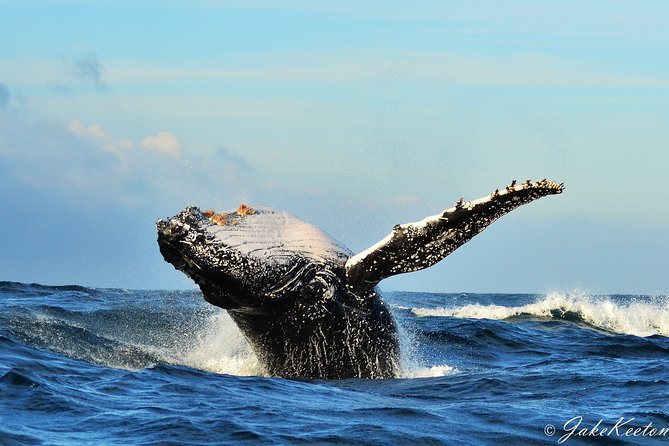
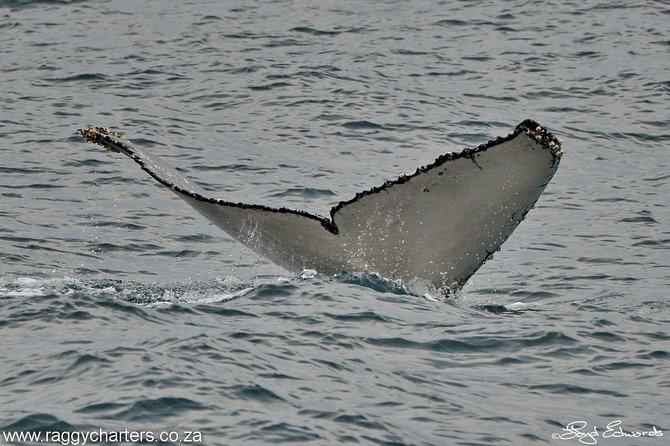
Whale watching is the big seasonal question. Humpback whales pass through Algoa Bay from June to early December as they move along the eastern coast of Africa toward breeding grounds. They begin returning from October, and females may be accompanied by calves.
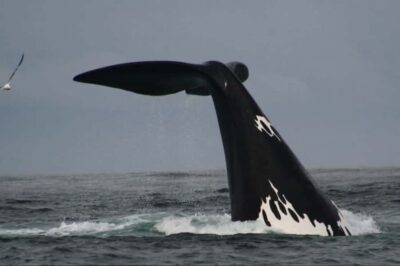
That makes late-season trips especially appealing if seeing a mother and young whale is high on your list. Still, no departure can promise a particular species or behavior. You may see a blow, a tail, or a whale close to the boat, but you may also spend time scanning broad stretches of water before anything appears.
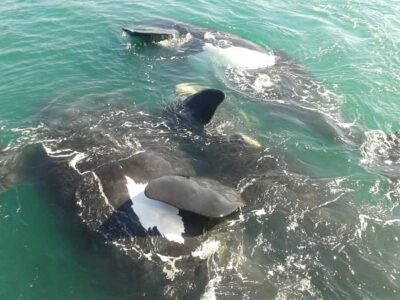
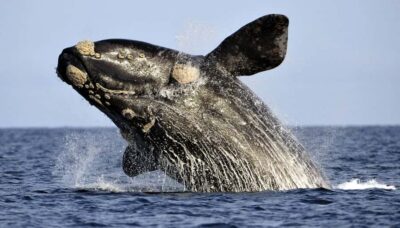
Southern right whales are usually seen close to shore from July through September. Bryde’s whales and minke whales are also possible, adding interest outside the main humpback season.
The value of having a conservation-focused crew becomes clear during quiet periods. Instead of treating an empty patch of sea as wasted time, the guide can explain migration, feeding patterns, and the bay’s food chain. You leave with more than a checklist of animals, even when the whales keep their distance.
For the strongest chance of seeing humpbacks, plan between June and early December. For southern right whales, July to September is the more useful window. The trip operates once daily, so build your schedule around the 8am start rather than expecting several departure choices.
Dolphins at the bow and beyond the islands
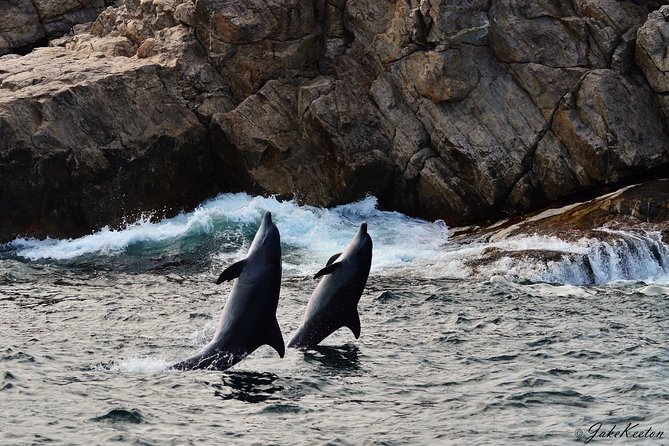
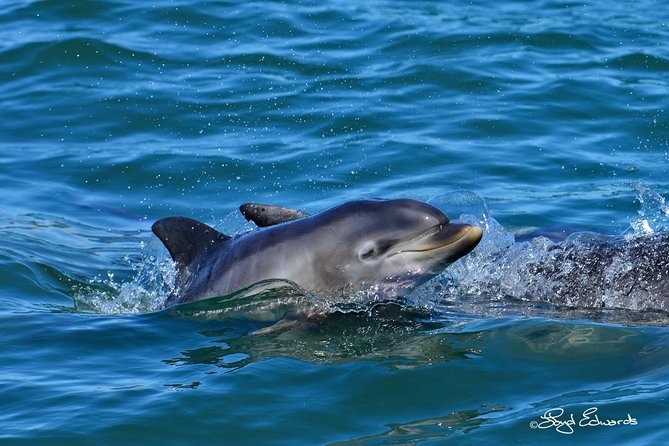
Indo-Pacific bottlenose dolphins are the most frequently seen dolphins in Algoa Bay. They live in shallow water near beaches and around St. Croix Island, and they can appear throughout the year in groups ranging from 10 to 400.
These dolphins are often the most active part of the cruise. They may approach the catamaran, ride the bow wave, and keep pace with the boat. When that happens, you get the kind of close encounter that works for both children and adults, since the animals are visible at the surface and may stay nearby for several minutes.
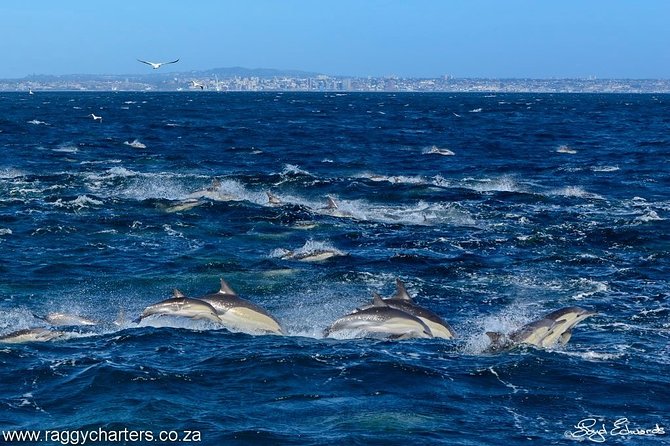
Common dolphins are another possibility. They are often found farther out, especially around the Bird Island group, and may travel in groups of 1,000 to 2,000 while following baitfish. A large pod moving quickly across the water can be more dramatic than a single close dolphin, though it may be harder to photograph.
Humpback dolphins also occur in the bay. The supplied information does not specify how frequently they are seen, so treat them as an additional possibility rather than a planned stop.
I like the range of dolphin encounters here. You might watch a small group surfacing beside the boat, or see a huge moving mass farther away. The difference is important: this is a natural-history trip, not a guaranteed animal performance. The crew searches, interprets, and respects the animals’ space.
St. Croix Island and the African penguins
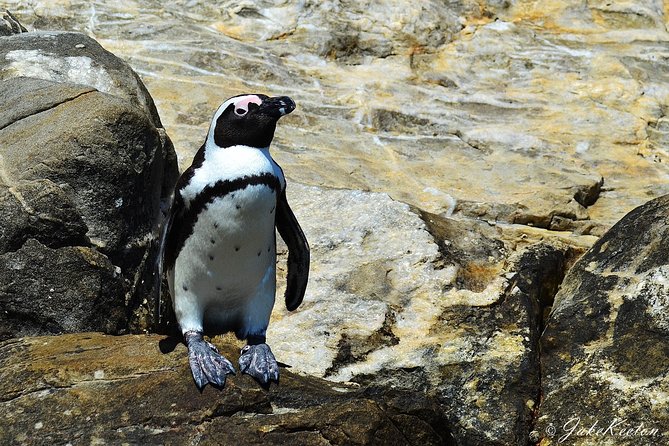
St. Croix Island is the main reason many people book this outing. The island is home to an important African penguin colony, and the boat lets you see these endangered birds from the water.
African penguins are at their most entertaining when they are busy. You might see them swimming out to feed, gathering near the island, or resting on the rocks. Their breeding season peaks from March through May, when chicks may be visible from the boat.
The conservation story is sobering. The colony has lost 70 percent of its population in 10 years, with overfishing identified as part of the wider problem affecting the birds. One of the strongest parts of this tour is that the guide does not separate the cute-animal moment from the hard facts. You see the penguins, then learn why their future is uncertain.
Do not expect to walk ashore at St. Croix Island. The experience is a close view from the catamaran, which helps limit disturbance to the colony. The island group is part of Addo Elephant National Park, and rangers patrol the area.
Penguin numbers can vary. A person booking mainly for a dense colony should keep expectations flexible. You may see only a smaller number of birds, or you may catch penguins actively hunting in the water. The island remains valuable even when the sighting is modest because it places the conservation issue right in front of you.
St. Croix and Brenton Island also support African black oystercatchers, white-breasted cormorants, and Cape cormorants. This is a useful reminder that the cruise is about a whole coastal ecosystem, not just three headline species.
Same country, a completely different kind of day:
- Full-Day All Inclusive Safari with Traditional Braai Lunch
★ 4.8 · 345 reviews - Port Elizabeth: Schotia Game Reserve Safari with Port Pickup
★ 4.5 · 263 reviews - Addo Elephant National Park All Inclusive Full-Day Safari
★ 5.0 · 256 reviews - Addo Elephant Full Day Safari with a Traditional South African Braai (BBQ) Lunch
★ 5.0 · 218 reviews
Seals, sharks, and the wider marine cast
The bay can produce far more than whales, dolphins, and penguins. Cape fur seals may be seen resting or swimming, and several shark species occur in the area. One especially memorable possibility is a hammerhead shark, though there is no promise of seeing one.
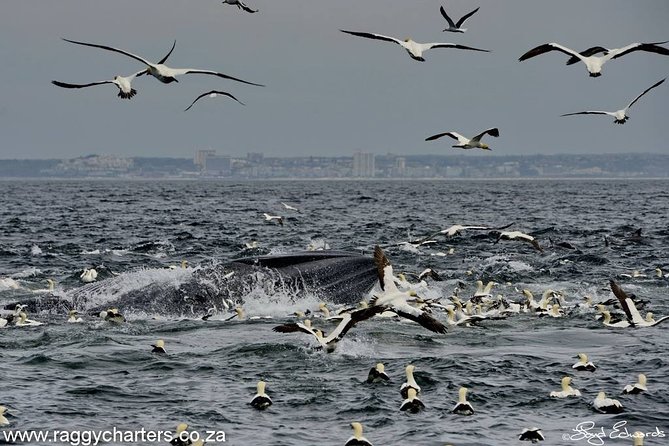
Birdlife adds another layer. Look for Cape gannets and pelagic species such as terns, petrels, skuas, shearwaters, and albatrosses. These birds may be less familiar than penguins, but the guide can help you understand why they are present and what they reveal about fish movement and ocean conditions.
The trip can also include Bryde’s whales, minke whales, and several cormorant species. This broad list is useful when deciding how to approach the outing. If you need one exact animal, the open sea may frustrate you. If you enjoy a changing set of possibilities, the variety makes the four hours worthwhile.
Bring patience. The boat may spend time traveling between feeding areas, islands, and stretches of open water. The reward can be a sudden pod of dolphins, a whale surfacing nearby, or penguins moving through the water. The less you expect a fixed sequence, the more enjoyable the day becomes.
What the small group changes
A maximum of 20 people is one of the tour’s best practical features. Small groups make it easier to hear a guide such as Jake without relying on a distant loudspeaker, and you can ask questions as the boat moves between sightings.
The crew can also respond to what is happening in front of them. If dolphins approach one side, the skipper can position the catamaran so more people have a view. If conditions become choppy, the crew can keep a closer eye on comfort and safety.
This is not the same as having a private charter. You still share the boat, and everyone will want a clear look when an animal surfaces. But the group limit should feel much more manageable than a large cruise excursion.
The slow pace has a tradeoff. A faster vessel might cover more of the bay, while this outing spends more time observing. I prefer the latter for a conservation trip, but people who want constant motion may find the approach too quiet during gaps between sightings.
Is $185.19 good value?
At $185.19 per person, this is not a budget harbor ride. The price makes more sense if you value a four-hour wildlife search with a small group, a dedicated crew, and a conservation message rather than a quick boat trip.
You are paying for time on the water, not a guaranteed animal count. The twin-engine catamaran, four-person crew, wildlife interpretation, and 20-person maximum all help explain the cost. The tree-planting campaign also gives the tour an environmental feature that many ordinary sightseeing cruises lack.
The value is strongest during a good seasonal window, especially June through early December for humpbacks or July through September for southern right whales. Dolphins are possible year-round, so the trip can still work outside whale season, but you should book it for the full marine experience rather than for whales alone.
One useful point comes from the booking choices: direct reservations may cost less than booking the same boat through a cruise excursion. If you are arriving on a ship, compare the options carefully. The timing, transfer arrangements, and return-to-ship schedule still matter, but the direct route may offer better value.
Practical details before you leave Port Elizabeth
You meet at Nelson Mandela Bay Yacht Club, Dom Pedro Jetty, Port Elizabeth Harbour, Gqeberha Central. The cruise ends at the same place after roughly four hours.
The start time is 8am, so allow enough time to reach the harbor and complete the briefing. The location is near public transportation, though the supplied details do not specify particular routes or transfer times.
Life jackets are available for all ages, and there is no age restriction. People with disabilities can join if they can board with help from family and crew. You should make your own call based on health and fitness, since the boat operates at sea and conditions may be choppy.
Wear clothing suited to changing marine weather. The information does not specify a required dress code, but a boat trip can feel cooler and wetter than the harbor. Protect your camera and phone, and keep a firm grip when photographing from the rail.
The trip depends on good weather and a minimum number of participants. If poor weather forces cancellation, you are offered another date or a full refund. The same applies if the minimum number is not met.
Free cancellation is available until 24 hours before the start time. Canceling or changing the booking inside that window does not qualify for a refund.
Who will enjoy this cruise most?
I would choose this cruise for anyone who wants wildlife without a large, noisy vessel. Families can appreciate the dolphins and penguins, while adults with an interest in conservation will get more from the explanations about fishing pressure, breeding colonies, migration, and habitat protection.
It also suits photographers who prefer time and positioning over speed. You may not get a perfect frame, but the small boat and attentive skipper improve your chances of seeing animals from a useful angle.
This is less suited to someone who needs a guaranteed whale sighting, has very limited time in Port Elizabeth, or dislikes open-water movement. The tour lasts about four hours, and nature may offer long quiet stretches before a memorable encounter.
Should you book the Algoa Bay cruise?
Book it if you want a careful, small-group look at Algoa Bay and can accept that the wildlife decides the schedule. The strongest reasons are the year-round dolphin potential, the St. Croix penguin stop, the wide range of possible seabirds and marine mammals, and a crew that treats safety and conservation as part of the experience.
For whale watchers, choose your dates thoughtfully. June through early December offers the main humpback window, while July through September is the better period for southern right whales. For everyone else, the dolphins and penguins keep the trip worthwhile outside those dates.
I would not book this as a guaranteed three-animal package. I would book it as a four-hour introduction to a living bay, where the headline sighting might be a mother and calf, a pod of 200 dolphins, penguins racing after fish, or an unexpected seal or shark. That uncertainty is part of the deal, and the crew’s calm, informed approach helps make it rewarding.
FAQ
Where does the cruise depart from?
The cruise departs from Nelson Mandela Bay Yacht Club at Dom Pedro Jetty, Port Elizabeth Harbour, Gqeberha Central, Gqeberha, 6001, South Africa.
What time does the cruise start?
The meeting time and start time are 8am.
How long does the experience last?
The cruise lasts approximately four hours.
Where does the cruise finish?
The activity ends back at the original meeting point at Nelson Mandela Bay Yacht Club.
How many people can join the boat?
The tour has a maximum of 20 people.
Can I see whales all year?
Humpback whales can be seen in Algoa Bay from June to early December. Southern right whales are usually seen close to shore from July through September. Whale sightings are not guaranteed.
Are dolphins visible throughout the year?
Indo-Pacific bottlenose dolphins and common dolphins can be seen all year. Bottlenose dolphins are often found near beaches and St. Croix Island, while common dolphins are often farther out.
What happens if the cruise is canceled?
If poor weather or an insufficient number of participants causes cancellation, you are offered another date or experience, or a full refund. You can also cancel for a full refund up to 24 hours before the start time.
Just added around Port Elizabeth
- KRAGGA KAMMA GAME PARK★ 4.3 · 9 reviews
- Kragga Kamma Game Park 4×4 & BBQ LUNCH★ 4.8 · 5 reviews
- Kragga Kamma Game Park★ 3.7 · 15 reviews
- Kragga Kamma Safaris And Shore Excursions★ 4.4 · 17 reviews
- Guided Port Elizabeth Coastal Tour★ 4.7 · 22 reviews
- Gqeberha: Park View Game Drive at Schotia Safaris with Lunch★ 5.0 · 7 reviews
- Gqeberha: 30 MINUTE HARBOUR CRUISE★ 4.3 · 8 reviews
- Addo Elephant National Park and Coastal Tour Combo★ 4.3 · 4 reviews
Whale Watching, compared.

Browse the lists this tour appears in