
Reviewed · CITY TOURS
Cape Town City and Woodstock Bicycle Tour
Cape Town’s story comes into focus on two wheels. This three-hour ride links the Old Biscuit Mill and Woodstock street art with District Six, Bo-Kaap, Company’s Garden, and the old city center, giving you a quick look at both the city’s creative side and its painful past.
I like the route’s range: you cover more ground than on foot, yet still stop for local stories and public art. I also like the small group, capped at 15 people, and the fact that guides such as Sipho and Terrence bring personal interest in the neighborhoods and art. The main consideration is pace: cycling between busy city sights may suit confident riders better than anyone wanting a slow, extended museum visit.
Key points to know before you book
- Woodstock gives the tour its artistic edge: Begin at the Old Biscuit Mill, a former factory now filled with food, shops, design, and street art.
- District Six adds serious historical context: The museum and surrounding area explain the forced removal of about 60,000 nonwhite residents during apartheid.
- You see the city center in one compact ride: The route can include Grand Parade, Greenmarket Square, St George’s Mall, Long Street, City Hall, and the Castle of Good Hope.
- Bo-Kaap brings culture and color: The neighborhood reflects the influence of freed slaves and Muslim immigrants from several parts of the Indian Ocean world.
- Bike hire and an entrance fee are included: You do not need to bring your own bicycle.
- Plan around the weather: Poor conditions can lead to a new date or a full refund, and cancellations are free up to 24 hours before departure.
Starting at Woodstock’s Salt Circle Arcade
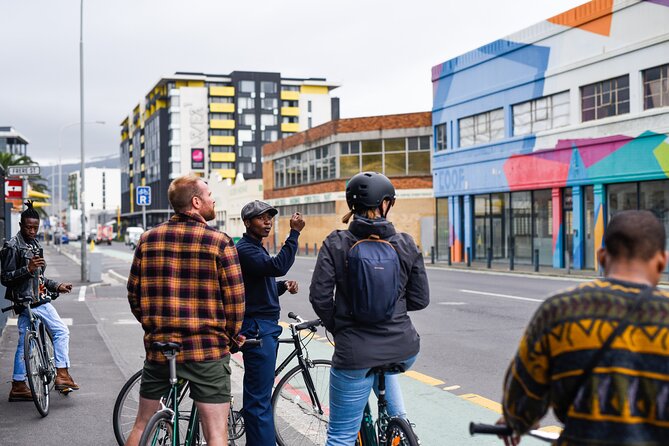
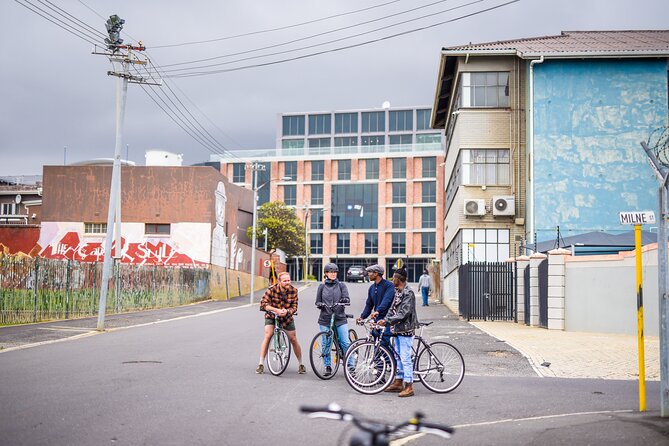
The tour begins at Shop 5 in the Salt Circle Arcade, at 374 Albert Road in Woodstock. This is not a downtown departure, so check your route to the meeting point before booking and allow enough time to arrive without rushing.
Starting in Woodstock is a smart choice. Rather than spending the entire ride on the familiar central sights, you begin in a neighborhood tied to Cape Town’s creative scene and then work your way toward the historic core. The meeting point also makes it easy to pair the tour with more time in Woodstock before or after your ride.
The activity lasts about three hours and returns to the same meeting point. A mobile ticket is accepted, and confirmation arrives when you book. Public transportation is nearby, though the supplied details do not specify which services stop closest to the arcade.
The group can have up to 15 people. That is small enough for a guide to answer questions and keep the ride together, though it is not a private tour. You receive a bicycle as part of the price, and an entrance fee is included. Extra purchases, food, drinks, and other personal costs are not covered.
A few more Cape Town trips to weigh up
- Cape Town Hop-On Hop-Off City Tour with Optional Cruise
★ 4.5 · 1,793 reviews - Cape Town: 12-Minute City Scenic Helicopter Tour
★ 4.8 · 853 reviews - Cape Town City Pass: Save Over 50% on 80+ Top Attractions
★ 4.5 · 348 reviews
Old Biscuit Mill and Woodstock street art
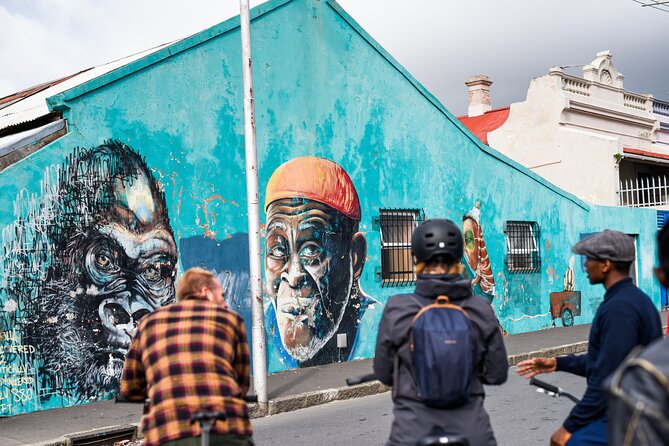
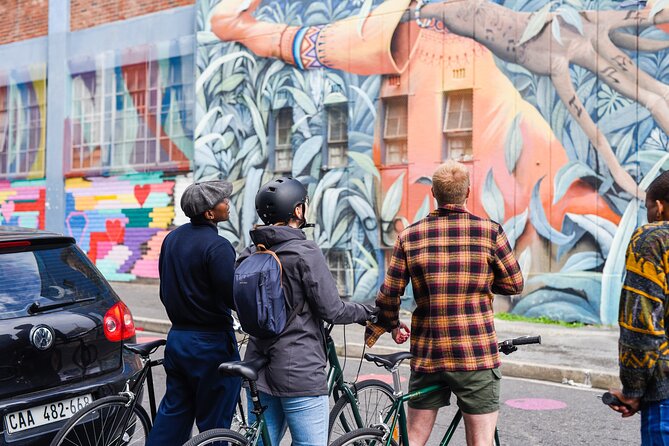
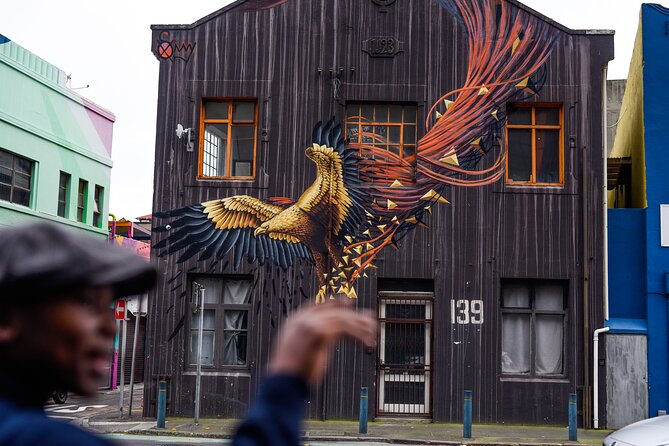
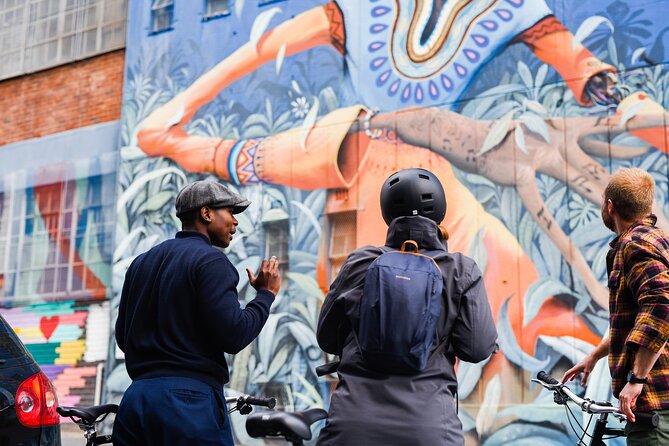
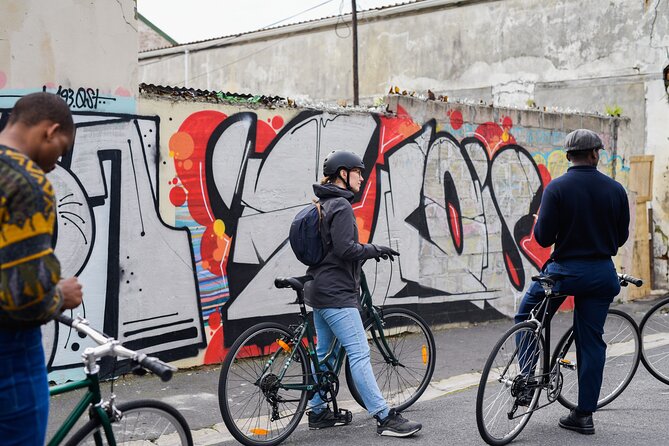
The Old Biscuit Mill is one of the most appealing early stops because it shows how an old industrial site can take on a new life. The former biscuit factory now houses boutiques, shops, restaurants, and creative businesses, with street art by local and international artists spread through the site and nearby streets.
This part of Woodstock gives the ride a modern Cape Town flavor. You are not only looking at monuments and dates. You are also seeing how design, food, art, and old buildings meet in one neighborhood.
If your tour runs on a weekend, the Neighbourgoods Market may add another layer to the visit. The market is known for food, shopping, and events, but market activity can also mean more people and less room to move around comfortably. The precise timing and length of the stop depend on the guide’s route, so treat the Old Biscuit Mill as a major setting rather than a guaranteed long shopping break.
The art focus is one reason to choose this tour over a standard city sightseeing ride. Guides Sipho and Terrence were praised for their interest in street art, and that matters here. A guide who can explain why a mural or neighborhood matters gives you more than a quick photo stop.
District Six, where the city’s past turns personal
District Six is the emotional center of the ride. The District Six Museum was founded in 1994 to remember the people who were forced from their homes after the government declared the area for white residents in the mid-1960s.
About 60,000 nonwhite residents were relocated to a township far from the city. Their homes were destroyed, and the removal broke up a long-established community. A stop here gives the rest of the city’s grand buildings a sharper context: Cape Town’s past is not only about Dutch forts, colonial gardens, and Edwardian halls.
The museum is an included stop when the route takes you inside, though the supplied details do not explain the length of the visit or exactly which entrance fee is covered. You should expect the subject matter to be difficult. This is not a light sightseeing pause, but it is an important one.
I like that District Six is placed beside the art and food stops rather than separated from them. Cape Town’s creative culture and its political history exist side by side. A bike tour can help you understand that geography because you physically move between the neighborhoods instead of seeing each attraction as an isolated point.
Grand Parade and Nelson Mandela’s public address
The route may continue to Grand Parade, a large open square with several layers of Cape Town history. The Dutch built their first fort here in 1652, and the area was later connected with the sale and punishment of enslaved people.
Grand Parade is also tied to Nelson Mandela’s first public address after his release from prison in 1990. He spoke from the balcony of the Old Town Hall, looking out over the square after 27 years in jail.
Today, part of the area may be used for a market and parking. That practical detail is worth keeping in mind. Grand Parade is historically important, but it may not look like a carefully preserved ceremonial plaza. The contrast between its busy present use and its major role in South African history is part of what makes the stop worthwhile.
Same country, a completely different kind of day:
- Wine Tour: Paarl, Franschhoek & Stellenbosch incl 3 wineries
★ 5.0 · 3,940 reviews - Cape Town: Hop-On Hop-Off Bus Tour with Optional Cruise
★ 4.8 · 3,929 reviews - Cape Town: Cape of Good Hope & Penguins Day Tour with Pickup
★ 4.7 · 3,362 reviews - Zipline Cape Town – From Foot of Table Mountain Reserve
★ 5.0 · 3,179 reviews
Bo-Kaap’s painted homes and layered culture
Bo-Kaap sits on the slopes of Signal Hill, just outside central Cape Town. Its brightly colored houses and lively streets make it one of the city’s most recognizable areas, but the colors are only the surface.
The neighborhood was one of the first settlements for freed slaves and Muslim immigrants in South Africa. Its cultural influences include Malaysian, Indian, Sri Lankan, and African traditions. That mix gives the stop a wider story than architecture alone.
A bicycle is useful here because the tour can connect Bo-Kaap with other central neighborhoods in the same outing. Still, streets can be active, and you should be comfortable riding in an urban setting. The guide’s chosen route determines how much time you spend here and whether the stop is a short look or a longer explanation.
I especially like Bo-Kaap as part of this particular tour because it prevents the day from becoming a parade of colonial landmarks. You get a sense of the people and communities who shaped Cape Town, not just the buildings left by colonial authorities.
Company’s Garden, a green pause in the city

Company’s Garden offers a change of rhythm. When the Dutch East India Company arrived in 1652, one of its first projects was a garden to help feed the settlement. The garden remains as a public park in the middle of Cape Town.
The stop helps you understand the city’s layout. After riding through streets, markets, and dense commercial areas, you reach a green public space used by both local people and visitors. It is a good place to pause, listen, and take in the surrounding city without needing a major attraction at every turn.
The garden’s story also ties directly to Cape Town’s beginnings. It is not simply a pleasant park. Its original purpose was practical and connected to the supply needs of the early settlement.
Do not expect the bicycle tour to give you the same amount of time as a dedicated garden visit. If you want a slow walk through every part of the park, return on your own later. Here, the value is seeing how the garden fits into the city’s history and present-day life.
Greenmarket Square and the everyday city
Greenmarket Square is one of the liveliest stops on the central route. The cobblestone plaza began as a slave market and later became a produce market. Today, vendors sell painted fabrics, handmade jewelry, and other small goods while performers add music and dance.
This is a place where you can browse, but keep the tour’s timing in mind. A short stop may give you a look at the square without leaving much time for serious shopping. If you find something you want, ask the guide how long the group will remain before making a purchase.
Greenmarket Square also shows how a public space can change purpose over time. Its present-day market atmosphere does not erase its earlier history. The guide’s explanation is important because the square’s meaning is easy to miss if you only see stalls and performers.
St George’s Mall and Long Street
St George’s Mall was once a congested city street and is now a pedestrian area in the center. Buskers, dancers, drummers, and street artists share the space with sidewalk cafés and restaurants.
This is a useful cycling stop because it shows the city center as a place where people spend time, not only a collection of monuments. You may need to walk your bicycle or follow the guide carefully in pedestrian-heavy sections. The exact riding conditions depend on the time of day and the route selected by your host.
Long Street adds another look at Cape Town’s culture and nightlife districts. It runs from the Cape Town Convention Centre through the central business district toward Kloof Street and has long attracted local and international visitors.
The tour may not cover the full length of Long Street. Its value is the connection between neighborhoods. In a short ride, you see how the city changes from industrial Woodstock to central commercial streets and older cultural quarters.
City Hall and the Castle of Good Hope
Cape Town’s old City Hall is a grand Edwardian building dating from 1905. Its balcony is the place where Nelson Mandela made his first public speech after leaving prison in February 1990.
The building is a strong visual counterpart to the political story at District Six. At one stop, you learn about communities pushed out of their homes. At another, you see the site of a speech that became a major public moment in South Africa’s transition.
The Castle of Good Hope adds an earlier colonial layer. This 17th-century bastion fort was built in Cape Town by the Dutch and once stood beside Table Bay. Land reclamation later left it inland, changing its setting but not its importance as one of the city’s major historic structures.
The Castle was declared a historical monument in 1936. An entrance fee is included in the tour, though the route may only allow a limited amount of time inside. If you want to inspect the fort at length, plan a separate visit. On this ride, the Castle works best as part of the larger story of Cape Town’s growth from a Dutch settlement into a modern city.
The supplied route also notes that additional stops can vary by guide. That flexibility can be useful because your host may adjust the ride to suit the day, the group, or current conditions. It also means you should not assume every listed location receives the same amount of time.
What the guide adds to the ride
The guide is central to this experience. The strongest praise goes to Sipho and Terrence, both described as friendly, engaged, and deeply interested in the art and neighborhoods along the route.
Terrence was particularly valued for the stories he told about local art and the area. Sipho was praised for answering questions and suggesting places to visit later. Those details point to the tour’s best use: treat it as an introduction to Cape Town, then return to the places that catch your attention.
The small-group limit of 15 helps. You can ask questions without speaking to a crowd, and the guide can usually keep an eye on the riders. Still, the group size is not a guarantee of a quiet ride or a private pace.
Because the tour is art and history focused, ask questions as you go. You will get more from the ride if you want to know why a neighborhood looks as it does, who shaped it, and how its past connects with its present.
Is $54.83 a fair price?
At about $54.83 per person, this is not the cheapest way to see Cape Town’s center, but the price includes bicycle use and an entrance fee. You are also paying for a guide, route planning, and the ability to connect Woodstock with central sights in roughly three hours.
The value is strongest if you have limited time in Cape Town. A walking tour would cover less ground, while exploring these areas alone would require more planning and several separate decisions about transport and route order.
The price is less attractive if you already have access to a bicycle and mainly want to browse the Old Biscuit Mill or spend a long time inside the District Six Museum or Castle. Those places deserve more time than a multi-stop ride can provide.
The tour is booked, on average, about 19 days ahead. That suggests you should reserve before your trip if your schedule is tight, especially since the maximum group size is 15. Free cancellation is available until 24 hours before the start time. Changes or cancellations inside that window are not accepted for a refund.
Good weather is required. If poor weather cancels the ride, you can receive a different date or a full refund. Bring only what you need for a three-hour ride, since the tour does not include additional food, drinks, or personal purchases.
Who should book this bicycle tour?
I would choose this tour if you want a broad first look at Cape Town and enjoy learning through movement. It suits people who want street art, public spaces, major landmarks, and difficult history in the same outing.
It is also a good match if you are staying in Cape Town for a short time. The route gives you ideas for later visits, and the guide can point out places worth returning to, as Sipho did for earlier groups.
You may want another type of tour if you prefer a slow museum day, dislike city cycling, or need a highly predictable route. Several stops can vary depending on the host, and the three-hour schedule means each location receives only part of your day.
The 4.7 rating from 15 ratings and the 93 percent recommendation figure suggest a strong overall response, with the guide’s character, local insight, art focus, and quality bicycles receiving the clearest emphasis. The sample is small, so I would treat those figures as useful signals rather than a guarantee that every outing will be identical.
Should you book it?
Book this ride if you want Cape Town explained through its streets rather than viewed only from a sightseeing vehicle. The combination of Woodstock art, District Six, Bo-Kaap, Company’s Garden, Mandela’s public landmarks, and the Castle gives you a useful sense of how the city was built, divided, challenged, and reshaped.
I would book it early, confirm the route and meeting instructions, and leave extra time for the Salt Circle Arcade. Choose it on a day when the weather looks sound and you are comfortable riding around an active city. For a short visit, the tour offers good value. For a slow, detailed examination of individual museums, return to those places separately.
FAQ
How long is the Cape Town City and Woodstock Bicycle Tour?
The tour lasts approximately three hours.
Where does the bicycle tour start?
It starts at Shop 5 in the Salt Circle Arcade, 374 Albert Road, Woodstock, Cape Town, 7925, South Africa.
Where does the tour end?
The activity ends back at the meeting point in the Salt Circle Arcade.
Is bicycle hire included?
Yes. Use of a bicycle is included in the tour price.
Is an entrance fee included?
Yes. An entrance fee is included, though the supplied details do not specify which individual attraction it covers.
How many people can join the tour?
The group can have a maximum of 15 people.
Can most people take part?
Yes. The activity information says most people can participate. You should still be comfortable riding a bicycle in an urban setting.
What happens if the weather is poor?
The experience requires good weather. If it is canceled because of poor conditions, you will be offered another date or a full refund.
Just added around Cape Town
- Private Tour to 20 Wine Tasting in Stellenbosch and Franschhoek★ 5.0 · 11 reviews
- Sunset Safari Big 5 Aquila with Snacks and Wine Tasting★ 5.0 · 12 reviews
- Robben Island, Kirstenbosch wine tasting Tour★ 5.0 · 10 reviews
- Zip Line and Wine from Cape Town★ 5.0 · 14 reviews
- Explore Atlantis Sand Dunes with a 1hour 30mins sandboarding tour★ 5.0 · 5 reviews
- Private Group Photoshoot in Cape Town★ 5.0 · 21 reviews
- Private Transfer from Cape Town International Airport★ 5.0 · 4 reviews
- 1 Hour Cape Town City Center Photoshoot Experience★ 5.0 · 19 reviews
City Tours, compared.
Cape Town Hop-On Hop-Off City Tour with Optional Cruise
Read our review →

Johannesburg Hop-On Hop-Off City Tour with Soweto Option
Read our review →
Jo’berg in 1 Day: Soweto, Apartheid Museum & City Tour
Read our review →
Cape Town City Pass: Save Over 50% on 80+ Top Attractions
Read our review →
Hop-On Hop-Off Bus, City Tour and Apartheid Museum
Read our review →

Browse the lists this tour appears in