
Reviewed · CITY TOURS
Durban City Sightseeing Tour
Durban makes its story visible in its food, waterfront, markets, and museums. This three-hour tour connects those pieces, from the Golden Mile and City Hall to Zulu artifacts at the Phansi Museum and the Indian influence found at Warwick Triangle.
I like the small maximum of eight people, which should make it easier to ask questions and hear the guide. I also like the mix of city sights and cultural stops, especially the Botanic Gardens and the chance to try bunny chow. The main catch is timing: three hours passes quickly, and the Phansi Museum is closed on weekends.
The guide team has included Wendy, Thompson, Leon, Paul, and Togo, with Togo described as a Zulu guide who finished the outing with bunny chow. The tour costs $52.59 per person, includes pickup and drop-off, but charges extra for Phansi Museum admission, food, drinks, and the Moses Mabhida cable car.
Key points to know before booking
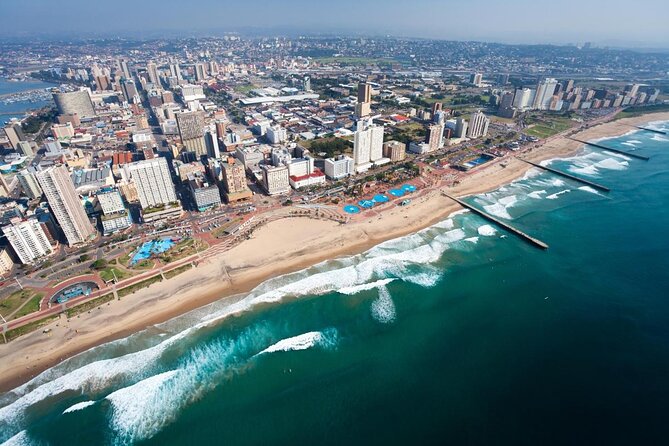
- Durban’s Golden Mile comes first: Expect beachfront hotels, restaurants, shops, and a look at everyday life beside the Indian Ocean.
- The Phansi Museum adds real cultural depth: Its collection includes beadwork, Zulu clay pots, headrests, jewelry, ceramics, and other Southern African objects.
- The Botanic Gardens date to 1849: You’ll see large trees from Africa, Asia, and the Americas, plus an orchid house.
- Warwick Triangle brings Durban’s Indian and African influences together: This market visit helps explain the city’s food traditions and working life.
- Bunny chow may be part of the experience: Food is not included, so plan to pay separately if you want to try it.
- The group stays small: A maximum of eight people is useful for questions, comfort, and a more personal guide experience.
Why this short Durban tour works well
Durban can be hard to read at first. Its broad beachfront suggests a resort city, while its markets, museums, and food point to a more layered past. This tour gives you a quick way to connect those impressions.
The central idea is Durban’s mix of Zulu, colonial, and Indian influences. Zulu communities shaped the region long before European settlement. Colonial development changed the city’s buildings and institutions. Indian immigrants arrived during the 19th century as indentured servants, and their presence helped shape Durban’s markets, neighborhoods, religion, and cuisine.
You will not get a full academic study in three hours. You will get a guided introduction, with a driver-guide explaining what you are seeing as you move between stops. That makes this a useful first outing, especially if you have limited time in Durban or want some context before exploring on your own.
The small group size matters here. With no more than eight people, the guide can explain details without fighting the noise of a large coach. Several guide names have been associated with the experience, including Leon, Paul, Wendy, Thompson, and Togo. The strongest praise has focused on friendly service, clear explanations, careful driving, and the ability to make the city feel approachable.
A few more Durban trips to weigh up
- Durban: City Sightseeing and Walking Tour
★ 4.6 · 98 reviews - Durban: Top 10 City Sights and Walking Tour
★ 4.1 · 69 reviews - Durban City Sightseeing and Walking Tour
★ 4.5 · 59 reviews
Starting at the Golden Mile beachfront
Pickup is offered from selected central Durban hotels, with the stated meeting point at the Hilton Durban, 12-14 Walnut Road. The tour begins at 9:00 am and returns to the meeting point at the end.
Your first major look at the city comes along the Golden Mile. This popular beachfront stretch is lined with hotels, restaurants, and shops. It is an easy place to notice how Durban uses the ocean as both a leisure space and part of daily life.
Look toward the water’s edge. You might see traditional healers collecting seawater in bottles for use as medicine. You might also see Indian women in saris walking along the beach. These details help move the tour beyond a simple drive past postcard views.
The beachfront is not presented as an isolated resort strip. It is part of a city where different traditions meet in public spaces. I like that the tour uses this drive to introduce Durban through ordinary scenes rather than only through major monuments.
The exact amount of time on the promenade is not specified, so do not expect a long beach walk. This is mainly a guided drive and sightseeing stop. If you want a swim, an extended stroll, or time at the shops, you will need to return later on your own.
City Hall and Durban’s civic center
The route continues past Durban City Hall. Your guide adds stories about the building and its past, including amusing details that make the stop easier to remember.
This part is brief, but it gives you a useful sense of Durban as a colonial-era city center. The tour can also provide views of the harbor and central city area, both noted as highlights by people who took the outing. Do not treat this as a full architectural tour. It is a moving introduction, with the guide supplying the background.
That approach suits the short format. Rather than spending the entire morning inside one building, you see several parts of Durban and get enough explanation to recognize them later. If you enjoy long guided talks at each monument, this tour may feel quick. If you want orientation, it does the job.
Phansi Museum and Southern African traditions
The Phansi Museum is the most focused cultural stop. Allow about 30 minutes, and remember that admission is not included in the tour price.
The museum is home to a large publicly accessible collection of Southern African artifacts and traditions. Displays include Zulu jewelry, beadwork, headrests, clay pots, ceramics, and other objects. The guide explores the museum with you, so the value is not only in looking at the objects. It is in hearing how they relate to Southern African customs and daily life.
I especially like this stop because it gives physical form to subjects that can otherwise remain vague. A mention of Zulu culture is easy to forget. A carefully made beadwork piece, clay vessel, or carved headrest gives you something concrete to remember.
The museum is closed to visitors on weekends. This is the most important scheduling detail in the whole experience. If you book for a Saturday or Sunday, confirm how the operator will handle the stop, since the advertised cultural visit cannot operate normally when the museum is shut.
The tour price does not include admission. That extra charge is modest in principle, but it matters when you compare the total cost with other city tours. Check the current admission amount before you go, since the supplied details do not state it.
Same country, a completely different kind of day:
- Durban: 30-Minute Harbor Boat Cruise
★ 4.7 · 665 reviews - Durban: 1-Hour Boat Cruise from Wilson’s Wharf
★ 4.7 · 496 reviews - Durban Point Waterfront: Luxury Canal Boat Cruise
★ 4.4 · 298 reviews - Durban: Pontoon Boat Harbor Cruise
★ 4.4 · 182 reviews
Botanic Gardens, founded in 1849
The Durban Botanic Gardens offer a change of pace after the city streets and museum displays. The gardens were founded in 1849 and contain large trees from Africa, Asia, and the Americas. An orchid house is also part of the visit.
The stated stop lasts about 20 minutes, with admission included. That is enough to see part of the grounds and hear an introduction, but not enough for a leisurely garden visit. If you are passionate about plants, you may want to return separately and give the gardens more time.
For most visitors, the short stop works as a breathing space. You can look up into mature trees, see how plants from several continents grow in Durban, and enjoy a quieter setting before continuing through the city.
The gardens also fit the larger theme of the tour. Durban’s story is not only about people and politics. Plants moved between continents too, through trade, colonial connections, and horticultural interest. You do not need to be a gardener to appreciate the contrast between the city streets and this older green space.
Warwick Triangle and Durban’s Indian influence
The tour includes a visit to the African and Indian Market at Warwick Triangle. This is one of the most useful stops for understanding Durban’s working city rather than its tourist front.
Warwick Triangle helps explain the influence of Indian immigrants who came to Durban in the 19th century as indentured laborers. Their descendants helped shape the city’s food, commerce, and cultural life. The market setting gives the guide a natural place to talk about those connections.
The food element is especially important. Durban is associated with bunny chow, a hollowed-out loaf of bread filled with curry. Food and drinks are not included, but bunny chow may be available as an optional purchase during or near the end of the outing.
One account of the tour describes finishing with a bunny chow meal at the wharf, guided by Togo. Treat that as a possible part of the route rather than a guaranteed included meal. If you want to sample it, bring money and ask your guide where the meal will take place.
Bunny chow is more than a snack for this tour. It gives you a simple way to understand how Indian cooking became part of Durban’s identity. I would rather learn that through a local dish than through a long list of dates.
Moses Mabhida Stadium and the optional cable car
The tour overview also allows time for a cable car ride to the top of Moses Mabhida Stadium. The ride is at your own expense, so it is not covered by the $52.59 tour price.
From above, you can take in wide views of Durban and the coast. The stadium is one of the city’s most recognizable modern landmarks, and the cable car adds a strong visual finish to a city orientation tour.
There is a practical question here: three hours is not much time for the Golden Mile, City Hall, Warwick Triangle, Phansi Museum, Botanic Gardens, food, and a cable car ride. The exact order and amount of time at each place may vary. Ask the guide at the beginning whether the cable car is planned for your departure and how much it will cost.
If the ride is important to you, budget for it separately. If you prefer museums, markets, and gardens, you may decide that your money is better spent on admission and food instead.
What the $52.59 price really covers
At $52.59 per person, this is not the cheapest way to move around Durban, but it includes several useful services. You receive hotel pickup and drop-off, a professional guide, transport between stops, the Botanic Gardens visit, and the Warwick Triangle market visit.
The maximum group size of eight improves the value. You are not paying for a private tour, but you are also not being placed on a large bus where the guide’s comments can get lost. Pickup is another practical benefit, especially if you are staying at a central hotel and do not want to arrange taxis between separate sights.
The price does not include Phansi Museum admission, food, drinks, or the Moses Mabhida cable car. Add those costs before deciding. The tour is best value when you want a compact introduction with transport and interpretation, not when you want a long stay at each attraction.
There must be at least two people for the tour to operate. Confirmation is sent within 48 hours of booking, subject to availability. Because the experience is non-refundable and cannot be changed for any reason, only book once your date and plans are firm.
Who will get the most from this experience
I would choose this tour if you have only one morning in Durban, are arriving without a car, or want a clear introduction before exploring alone. It is also a good fit if you care about the city’s cultural mix and would rather see a museum and market than spend the whole outing on the beachfront.
Families can participate, and most people can take part. Children up to age three must sit in a car seat. Seats depend on availability, so parents may bring their own.
The outing may also suit older visitors or anyone who prefers vehicle-based sightseeing, since it links several parts of the city without requiring long walks between them. One account describes a guide responding kindly when a participant became ill, but you should still carry suitable personal travel insurance and tell the operator about any concerns before departure.
The tour is less suitable if you want an unhurried garden visit, a long museum session, or a guaranteed meal. The three-hour schedule is designed for coverage. You will see more places, but you will not have much spare time at each one.
Practical advice for a better morning
Confirm the pickup point when you book, particularly if you are not staying at the Hilton Durban. The published meeting point is the Hilton at 12-14 Walnut Road, while pickup is offered from selected central hotels.
Wear comfortable clothing for getting in and out of the vehicle and walking through the gardens, museum, market, and beachfront areas. Bring money for Phansi Museum admission, bunny chow or other food, drinks, and the cable car if you want those extras.
Ask whether the Phansi Museum is operating on your chosen date. Weekend closure is a firm limitation, and it could change the balance of the tour.
It is also worth asking your guide how the morning will be timed. The listed stops include 20 minutes at the Botanic Gardens and 30 minutes at the Phansi Museum, but the beach, market, City Hall, meal, and stadium ride also compete for the remaining time.
The operator follows South African government-approved TBCSA health and safety protocols. If you show COVID-19 symptoms, testing and quarantine costs are your responsibility. Personal travel insurance is recommended.
Should you book the Durban City Sightseeing Tour?
Book it if you want a compact, small-group introduction to Durban with hotel transport, a cultural museum, the Botanic Gardens, the Golden Mile, and Warwick Triangle. The guide’s role is central, and the named guides have been praised for friendly service, clear explanations, good driving, and a willingness to make the outing comfortable.
The best parts are the range of experiences and the chance to connect Durban’s Zulu, colonial, and Indian influences in one morning. The main weaknesses are the tight schedule, extra charges, and weekend closure of the Phansi Museum.
I would book this for a first morning in Durban, then return to the places that deserve more time. Check the museum day, confirm the pickup, and budget for the optional food and cable car. With those details settled, the $52.59 price is fair for a guided orientation in a small group.
FAQ
Where does the tour start?
The stated meeting point is the Hilton Durban at 12-14 Walnut Road, Durban Central, Durban, 4001, South Africa.
What time does the tour begin?
The tour starts at 9:00 am.
How long does the tour last?
The experience lasts approximately three hours.
Is hotel pickup included?
Yes. Pickup and drop-off are included from selected central Durban hotels.
What is the maximum group size?
The tour has a maximum of eight people.
Is admission to the Botanic Gardens included?
Yes. Admission to the Durban Botanic Gardens is included.
Is admission to the Phansi Museum included?
No. Admission to the Phansi Museum is not included.
Is food included?
No. Food and drinks are not included unless specifically stated. Bunny chow may be available to purchase separately.
Is the Phansi Museum open on weekends?
No. The Phansi Museum is closed to visitors on weekends.
Can young children join the tour?
Yes. Children can participate, but children up to age three must use a car seat. Car seats depend on availability, and parents may bring their own.
What happens if I cancel?
The experience is non-refundable and cannot be changed for any reason. The amount paid is not refunded if you cancel or request an amendment.
Just added around Durban
- Zululand 5 Day Private Safari from Durban★ 5.0 · 4 reviews
- Valley of a Thousand Hills – Durban★ 5.0 · 3 reviews
- Zulu Cultural Experience – Tour to the village of iSithumba and PheZulu★ 5.0 · 4 reviews
- Zulu Cultural Experience: Zulu Village + Tribal Markets + Traditional Zulu Food★ 5.0 · 5 reviews
- Drakensberg, Nelson Mandela Capture S & Howick Falls – 2 Day Tour from Durban★ 5.0 · 3 reviews
- Garden Route Durban to Cape Town via Addo National Park – 7 Days★ 5.0 · 15 reviews
- Full Day-Drakensberg-MandelaCaptureSite-HowickFalls-MidlandsMeander from Durban★ 3.5 · 11 reviews
- Durban: Journey along the Epic Sani Pass & Lesotho Tour★ 5.0 · 7 reviews
City Tours, compared.
Cape Town Hop-On Hop-Off City Tour with Optional Cruise
Read our review →
Johannesburg Hop-On Hop-Off City Tour with Soweto Option
Read our review →
Jo’berg in 1 Day: Soweto, Apartheid Museum & City Tour
Read our review →
Cape Town City Pass: Save Over 50% on 80+ Top Attractions
Read our review →
Hop-On Hop-Off Bus, City Tour and Apartheid Museum
Read our review →

Browse the lists this tour appears in